-
Title of Story
-
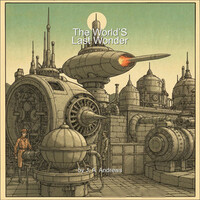
The World's Last Wonder
-
Attributed Author
-
Unattributed (Later attributed to John Arthur Andrews)
-
Year For Sorting
-
1901
-
Future Year Set
-
Contemporary
-
Story Summary
-
Australia's First Space Opera. The inventor takes his friend and others on a journey to Mars in competition with someone who had stole his patent for his space car. The antagonist's car is called The Annexator and their plan is to claim Mars for themselves, and have even kidnapped the girlfriend of one of the passengers on the protagonist's ship. A tense nailbiting situation mid story as both ships link up and attempt exchanging documents in a vacuum, even though neither car had been designed with an air lock. Landing on Mars, the protagonists meet two intelligent species and detail the attempts to communicate. Unfortunately, the antagonists' prior landing had eventually caused the inhabitants to realise humanity is dangerous and force the protagonists off planet and determine Earth is now under quarantine. This summary does not do the huge amount of science and inventions in this story justice. A critical scholarly digital edition is available for download.
-
Critical Introduction
-
During the period the vintage science fiction story The World’s Last Wonder was published, the sub-genre of space opera wasn’t yet known as that. Instead, ‘planetary fiction’ was used by reviewers to describe a story that featured a world in space other than Earth.
So, considering this from the vantage point of 2023, The World’s Last Wonder is arguably Australia’s first published and serialised space opera (until an earlier one is discovered).
First published Thursdays in The Tocsin newspaper 14 February to 16 May 1901 across 14 issues, it is an amazing example of Australia’s golden age of newspaper science fiction.
While several of the science and scientific discoveries and references described in the story are still accurate over 125 years later, to some extent, (we have yet to find one intelligent species living on Mars, let alone two), there are some interesting linguistic differences when comparing this to British and American space opera. For example, this text uses ‘cars’ instead of ‘ships’ to describe the space-going vehicles. Communication between the space cars Pioneer and the Annexator is made with Morse Code signalling ‘lamps’ that need to be extinguished and reignited, so, not electric lights, even though electricity was mentioned earlier in chapter II. There are other examples of linguistic differences, or planetary fiction ‘markers’, which would make finding this story by searching with keywords that are common to 21st century space opera, difficult. Missing are words such as aliens, Deimos, Phobos, technology, rocket, laser, oxygen, spacesuit, astronaut, captain, anti-gravity, and a lot more besides.
However, the sentence ‘scanning for signs of life’ or, in this story’s case in chapter X, ‘scanning the surface for signs of life’ a common phrase in Star Trek and other space faring TV shows, turns out to be centuries old. It is still being used today in the way it has always been used – exploring the sea. This expression has been used in fiction writing since at least the early 1800s in a variety of genres and is not specific to space opera.
While there are some satirical passages, I’d like to clarify that the entire story is not a satire. In this text, satire functions as a tone, a small element, for example when the Martians don’t believe the narrator when he tries to explain Earth’s social differences, and Solomon and Fisher’s capitalist caricatures are deliberately two dimensional. However, these are minor compared to the inventiveness, ingenuity and seriousness of the majority of its story and its politics.
It might be easier to understand the story as a genre hybrid of scientific romance, utopian ideas, and some political allegory. There is also a thread of anarchism, with commanding a police officer, ignoring rules, considering vigilante acts, rejecting higher authorities, discussing an honourable sacrifice, as well as the escape from Earth being a metaphor for breaking free of not just gravity but social constraints. Interestingly, it is also a message of fighting for rights. Rights to patents. Rights to property. Rights to independence. Rights to Freedom. A serious allegory rather than a light satire.
More importantly, it ticks the boxes of Suvin’s (1979) ‘cognitive estrangement,’ a requirement of science fiction, especially with the later chapters exploring xeno-linguistics, preceding Lem’s Solaris (1961 Polish), Le Guin’s Rocannon’s World (1966), and Chiang’s Story of Your Life (1998).
It is unfortunate that the first Australian space opera story has been listed as anonymous or unattributed for 125 years. I conducted stylometric analysis, comparing articles written by some of the known writers of The Tocsin within and outside it, with the chapters of this story. Using Stylo-R-Package4, 320 articles were analysed and compared to 14 chapters of The World’s Last Wonder. Results were inconclusive so are not reproduced here. Then I conducted a detailed examination of the biographies of several who had written for the Tocsin. One that I had already considered as a possible collaborator suddenly became the only person who could have written it (apart from help from editors). Theoretician, writer, poet, inventor and linguist John Arthur Andrews (J. A. Andrews) 1865-1903. Here I outline the reasons for the Andrews attribution -
a) James (1986) points out that “Part of [Andrews] prodigious prose output was science fiction” and points to the Mitchell Library of the State Library of NSW containing some of Andrews’ papers, including an unfinished science fiction novel.
b) Hearn (2012) says that Andrews “dabbled with science fiction” and points to a copy of "Adventures on Mars" as a derivative story reflecting Wells and Verne storylines involving solo traveller Professor A. Mann visiting Mars inhabited by two races, one of man-like creatures and one of spiders.
c) While a) and b) seem conclusive together, considering man-like creatures and spider-martians also appear in The World’s Last Wonder, it needs to be proven that this story is not a coincidence. To this I point to several passages throughout this text that reflect Andrews’ views. For example, his "Handbook of Anarchy" talks about how the world forces people into tenancy. Here he starts with the pain of landlords and ends with explaining to spider-martians the illogical system of capturing land then charging people to live there. In an essay he says “people’s own force” keeps them in bondage, not just the elite. The Spider-Martian says after being explained the concept of rent and property ownership, “Some of the inhabitants of the Earth are insufferably impudent and the rest incalculably foolish." I suggest that The World’s Last Wonder is the more mature version with the unpublished "Adventures on Mars," being an earlier, discarded version. Update: I now have a scanned copy of Andrews' handwritten story from the Mitchell Library and can see many similarities.
e) There are some minor tonal shifts throughout that suggest additional writing influences, such as the sudden appearance of a new American character of Fred Reiver, and his abducted love interest Alice Beston, as well as the brief comforting handholding of the male narrator with Reiver in a time of crisis. As Bernard Patrick O’Dowd was a close friend, and editor of The Tocsin at the time of publication, perhaps his editing was a bit more extensive.
The World’s Last Wonder is also a great example of the kind of space opera that Australians are capable of, and I hope you enjoy it as much as I did.
-
Science
-
low thrust for continuous acceleration in space
-
radiation pressure
-
molecular vibration
-
gravity-assisted manoeuvres
-
kinetic theory of gases
-
Astronomy
-
Cometary effects on planets
-
earthquake detection and seisometres
-
angular motion
-
orbital mechanics
-
radial intensity of gravity
-
Newtonian physics and microgravity
-
aligning molecules for virtual photon pressure
-
Planetary gravitation levels
-
Inventions
-
Radiomotor
-
Spacecar
-
Earthquake Detector (though may operate as a radar)
-
Space signalling lamps
-
Air filter
-
A space car designed with the lack of up or down in mind
-
Small tube air lock created in the story for joining the spacecars to exchange reading material
-
Science Communication Example
-
"Besides the main Radiomotor, intended to furnish the lifting power, there were several subsidiary ones arranged for steering, it being merely necessary, when not too high up from the earth, to point one or more of them to the horizon in the direction away from which it was desired to travel. At greater heights, where the thrusts obtained off the different parts of the earth would be too nearly parallel with each other to steer by, the requisite cross- thrust was to be obtained from the Moon as the subsidary base of repulsion. The car itself was a series of walls or shells, having the spaces between them filled with various kinds of packing, chiefly for the regulation of the internal temperature, but also as a partial protection from the assaults of meteoric stones, which, circulating abundantly in space, might come into collision with our vehicle. These flying fragments would cause a very appreciable danger at the earth's surface if it were not for the atmosphere, which intercepts most of them and burns them up harmlessly as 'shooting stars.'"
-
Science Future Articles
-
The idea of interplanetary travel was discussed shortly after by the well-known rocket scientist Konstantin Tsoilkovsky who said that he was inspired by the fiction stories of Jules Verne. Исследование мировых пространств реактивными приборами [Exploration of Outer Space using Jet Devices] 1903.
-
Lebedev confirmed radiation pressure and published results in 1901, first theorized by Maxwell in 1871. https://arxiv.org/abs/1005.4913
-
Molecular vibration had been a theory since the Pythagoreans but wasn’t proven until Raman 1928. Converting these vibrations to propulsion may be a reference to Maxwell’s Demon (1867) which was a thought experiment of a microscopic intelligence that could sort the molecules into fast and slow streams. Interesting that Sir William Crookes (1873) created a device that moved due to thermal respiration. He called it the Radiometer!
-
Amazing that this story predicts gravity-assisted manoeuvres, first theorised by Kondratyuk in 1918 but not published until the 1960s. https://link.springer.com/article/10.1007/s40430-020-02489-x Zander published his in 1925. Soviet Probe Luna 3 first used gravity assist in 1959. Later, gravity assisted manoeuvres were used in NASA’s Voyager, Galileo and Cassini missions.
-
The protagonists feared the effects of comets. Krasnopolsky (1997) and Uchida et al (1998) confirmed that comets don’t internally produce radiation but in reaction to solar winds they do produce x-rays.
-
The way the radiomotor works suggests an understanding of energy containing a fundamental unit, first theorized by Albert Einstein in 1905 and later named photons. From this perspective, aligning molecules (photons or virtual photon pressure) generating energy from space itself (fluctuations in the EM fields in the vacuum) point to zero-point energy (Einstein-Stern 1913) and quantum electrodynamics (Dirac 1928).
-
The Spider-Martian’s rejection of the scientific research idea brings to mind Japanese whaling since 1986 being “scientific research.” https://www.theguardian.com/environment/2015/jun/19/japan-asked-to-prove-whaling-for-scientific-research
-
Science Past Articles
-
Harnessing the rays of his invention may have been influenced Curie’s discovery of rays from thorium compounds in 1898. https://pmc.ncbi.nlm.nih.gov/articles/PMC6964347/ and possibly inspired by this article: https://trove.nla.gov.au/newspaper/article/138673219/11316184
-
Discussions on gas molecules could be a reference to Bernoulli’s (1738) kinetic theory of gases, still a fundamental theory in physics. Possibly inspired by this article: https://trove.nla.gov.au/newspaper/article/138612341
-
Discussion of meteors throughout may have been inspired by this article: https://trove.nla.gov.au/newspaper/article/138613138 or this letter to the editor: https://trove.nla.gov.au/newspaper/article/193703339
-
Predicting the need for seismometers in space. Possibly inspired by reports of seismometers being used to detect trains in Japan. https://trove.nla.gov.au/newspaper/article/138663442 However, seismometers need at least an atmosphere to measure shockwaves, so the earthquake detector, considering everything else about the ship is using radio waves or electromagnetic radiation, should have been called a radar.
-
A reference to angular motion, possibly using calculations from Airy’s 1834 book on gravitation: https://archive.org/details/gravitationeleme00airyrich Although, in 1898, The Concise Knowledge Library of Astronomy was released in Australia, which contains “an outline of the general principles of spherical and gravitational astronomy,” and would have been available in libraries in Melbourne. https://trove.nla.gov.au/newspaper/article/197308368
-
Discussions may be influenced by Kepler and Newton’s laws, and an understanding of orbital mechanics. Possibly inspired by this article’s sections Other Worlds, The Law of Gravity and How the Planet’s Spin, though the creative writing about possible inhabitants might also have influenced later chapters: https://trove.nla.gov.au/newspaper/page/26239246
-
Meteorite activity was regularly reported in newspapers along with scientific explanations. E.g. https://trove.nla.gov.au/newspaper/article/89473958
-
Discussed the possibility of the other space car going on forever, understanding that in space, that is most likely. Also perhaps a reference to the Mystery of the Marie Celeste, perhaps inspired by this article: https://trove.nla.gov.au/newspaper/article/150445559
-
Predicts the technical challenges of docking spacecraft which was finally achieved in 1966 with Gemini 8 docking with an Agena target vehicle. Airlocks already existed in submarines by this time such as in The Argonaut in 1898. https://trove.nla.gov.au/newspaper/article/68691386
-
The electrical disruption was possibly inspired by this article about Tesla’s discoveries: https://trove.nla.gov.au/newspaper/article/282809227
-
Cautiously rejecting Schiaparelli and Lowell’s idea of artificial canals on Mars, possibly inspired by this article: https://trove.nla.gov.au/newspaper/article/285392537 and an understanding of seeing patterns in randomness - what was to later be called by Conrad ‘pareidolia’ (1958).
-
Flammarion discussed signalling Mars from Earth with lights in 1897. 1898 article on communicating with Mars: https://trove.nla.gov.au/newspaper/article/89465696
-
This shows an understanding of bioacoustics in insects and how some communicate through vibration, possibly inspired by this article: https://trove.nla.gov.au/newspaper/article/139777134
-
By the 1890s astronomers knew Mars gravity to be roughly 38% that of Earth thanks to Gill’s parallax measurements of Mars in 1877. Flammarion’s 1896 calculations suggest gravity was believed to be around 37.6% of Earth’s. https://www.jstor.org/stable/25118640
-
The story contains an understanding of Phobos’ orbit, Martian moons and general orbit mechanics, Phobos only having been discovered in 1877 by Asaph Hall. https://trove.nla.gov.au/newspaper/article/285392537
-
Science Extrapolations
-
Arthur C. Clarke (1964) would later have a similar propulsion idea in The Wind from the Sun. NASA later used solar sail propulsion in its IKAROS project (2010)
-
Discussion on steadily increasing speed in space: This was finally put into practice in 1998 with NASA’s Deep Space 1 spacecraft, and in 2007 with NASA’s Dawn space probe, both featuring ion engines generating a low-thrust continuous acceleration to reach high velocities.
-
While air locks parallels submarine technology, its use in spacecraft wasn’t realised until decades later. Also, as the insulated car is designed for long term space travel, space science didn’t reach this level of advancement until at least the 1960s with NASA’s Apollo missions.
-
A sharp image of the sun against a black background had been a theory for many years but wasn’t confirmed until astronauts began leaving the atmosphere.
-
Newtonian understanding of the radial intensity of gravity, however, narratively more extreme than reality.
-
Bioacoustics was the subject of a paper by Johann Regen (1913) https://scispace.com/papers/uber-die-anlockung-des-weibchens-von-gryllus-campestris-l-u9v3gk599t
-
While the phonograph had been created by Edison in 1877 and built by his mechanic John Kruesi, https://www.loc.gov/collections/edison-company-motion-pictures-and-sound-recordings/articles-and-essays/history-of-edison-sound-recordings/history-of-the-cylinder-phonograph/ , it and successive versions at the time were large pieces of equipment. Andrews predicting a smaller, lighter version shows an understanding of the many stages of invention development and redesign, perhaps also shows he foresaw the future miniaturization of electronics.
-
NASA later confirmed that the gravity of Mars is globally 38% that of Earth but fluctuates slightly across the seasons. In any case, representing this in a story was rare in vintage science fiction and has become more common in modern science fiction
-
As far as I know this is the first time that a science fiction story has quarantined the Earth. In fact, since this time several stories and TV shows have featured the Earth being quarantined. Usually humorously, as in the South Park episode Pinewood Derby (2009) though sometimes dystopically as in the 2008 version of the movie The Day The Earth Stood Still. It might also be a nod to the discussions of the time that still take place today. “Why haven’t aliens contacted us yet?” Probably because we’ve been quarantined by them.
-
The Other
-
Initially, the working class inventor's space car competes against 'The Other', the capitalist who they cannot fathom who has stolen the plans and made his own space car to claim Mars. More Others appear in space itself being alien and unpredictable before the team land on Mars and meet the incomprehensible alien other. Bug like humanoids who communicate with vibration and spider like elders who can weave words with their webs and maintain the harmony of the groups, both beings while having some analogue to Earth insects and arachnids, require extensive interaction before some sense of knowing and communication can be begun between all three disparate groups.
-
Science Fiction Subgenres
-
Colonial
-
Exploration
-
Alien First Contact
-
Invention Opera
-
Planetary
-
Space Fiction
-
Space Opera
-
Xeno
-
Similar Science Fiction
-
Out of the Silent Planet (1938) C. S. Lewis
-
The Sands of Mars (1951) Arthur C. Clarke
-
Solaris (1961 Polish) Stanisław Lem
-
Rocannon's World (1966) Ursula K. Le Guin
-
Mars (1992) Ben Bova
-
Story of Your Life (1998) Ted Chiang
(Also Arrival (movie) 2016)
-
The first chapter's satirical soft introduction section, set in contemporary times, is a common trope, easing the reader into the later science-focused narrative. This mixed genre approach became popular in introducing new readers to science fiction, and is still used today in science fiction movies, e.g.: Arrival (2016), The Wandering Earth (2019), Proximity (2020), The Creator (2023).
-
Related Newspaper Fiction
-
An Aerial Adventure or The Secret of a Scientist (1910) by Victor D. A. Courtney
-
The Dark Planet (1913) by Charles H. Hunt
-
Space (1934) by Archibald Low
-
Venus Calling (1934) by Frank H. Bodle
-
Related Paratext
-
Advertisement for a guidebook to patenting inventions.
-
Science articles.
-
Historical Context
-
1898-1901. Australia was about to be Federated, discussions had begun on implementing an Immigration Restriction Policy (The White Australia Policy) and America had annexed Hawaii and it was believed it was planning to annex The Philippines. Also, the past few years had featured science conventions in Melbourne along with electricity being quickly installed around the city replacing gas lamps. Canals on Mars were still being debated and some inventors had even tried to contact the inhabitants of Mars. It was an exciting and anxiety-inducing time.
-
Mentioned Elsewhere
-
Australian Utopian Literature: An Annotated, Chronological Bibliography 1667-1999. Utopian Studies, 1999. Vol. 10. No. 2 (1999), pp. 138-173 https://www.jstor.org/stable/20718099
-
Audio of all the chapters featured in series 2 of The Vintage Sci Fi Podcast: https://vintagescifiguy.com/podcast/
-
Relation
-
Coming Soon
-
Other Works by the Author Listed in the Newspaper
-
NA
-
How this Story was Identified
-
After exporting files from the To Be Continued Australian Newspaper Fiction Database (2023 version) I searched the database with longer and longer keyclouds, discovering more science fiction as I developed the method. This story was the earliest found with just the keycloud below.
-
KeyClouds
-
gravity scientist interplanetary
2 found, one discarded as not science fiction.
-
Date Details Added to IA
-
February 2023
-
Author Gender
-
Male (AustLit) https://www.austlit.edu.au/austlit/page/A14050
-
Nationality
-
Australian
After determining that it must have been written by John Arthur Andrews
-
Single or Serialised
-
Serialised
-
First Published Date of Last Installment
-
1901-05-16
-
Date Range
-
1901-02-14-1901-05-16
-
Number of Installments
-
14
-
Complete or Supplemented
-
Complete
-
Estimated Word Count
-
19,400
-
Length
-
Novella
-
Book Release Details
-
NA
-
Links to Trove
-
https://trove.nla.gov.au/newspaper/article/197525101
The World's Last Wonder Chapter I. Thursday 14 February 1901 page 7. The Tocsin
https://trove.nla.gov.au/newspaper/article/197527783
The World's Last Wonder Chapter II Thursday 21 February 1901 page 6. The Tocsin Newspaper.
https://trove.nla.gov.au/newspaper/article/197523678
The World's Last Wonder Chapter III Thursday 28 February 1901 page 9. The Tocsin Newspaper.
The World's Last Wonder Chapter IV Thursday 7 March 1901. The Tocsin Newspaper. This is is not available on Trove at this time
https://trove.nla.gov.au/newspaper/article/197525761
The World's Last Wonder Chapter V Thursday 14 March 1901 page 6. The Tocsin Newspaper.
https://trove.nla.gov.au/newspaper/article/197526718
The World's Last Wonder Chapter VI Thursday 21 March 1901 page 6. The Tocsin Newspaper.
https://trove.nla.gov.au/newspaper/article/197523711
The World's Last Wonder Chapter VII Thursday 28 March 1901 page 8. The Tocsin Newspaper.
https://trove.nla.gov.au/newspaper/article/197527350
The World's Last Wonder Chapter VIII Thursday 4 April 1901 page 3. The Tocsin Newspaper.
https://trove.nla.gov.au/newspaper/article/197527277
The World's Last Wonder Chapter IX Thursday 11 April 1901 page 3. The Tocsin Newspaper.
https://trove.nla.gov.au/newspaper/article/197522625
The World's Last Wonder Chapter X Thursday 18 April 1901 page 2. The Tocsin Newspaper.
https://trove.nla.gov.au/newspaper/article/197527920
The World's Last Wonder Chapter XI Thursday 25 April 1901 page 3. The Tocsin Newspaper.
https://trove.nla.gov.au/newspaper/article/197524044
The World's Last Wonder Chapter XII Thursday 2 May 1901 page 2. The Tocsin Newspaper.
https://trove.nla.gov.au/newspaper/article/197526037
The World's Last Wonder Chapter XIII Thursday 9 May 1901 page 2. The Tocsin Newspaper.
https://trove.nla.gov.au/newspaper/article/197527496
The World's Last Wonder Chapter XIV Thursday 16 May 1901 page 2. The Tocsin Newspaper.
-
Newspaper Publisher Citation
-
The Tocsin
-
Newspaper Name Location Years
-
The Tocsin, Melbourne, Victoria, Australia, 1897-1906
-
Location Town City
-
Melbourne
-
Location State Territory
-
Victoria
-
Provincial or Metro
-
Metropolitan
-
Also Published in
-
NA
-
First Republished on InfiniteAnthologies.com
-
YES
-
General Subjects
-
science fiction
-
Australian science fiction
-
Australian newspaper fiction
-
Australian fiction
-
newspaper fiction
-
creative writing
-
speculative fiction
-
fiction
-
story
-
Vintage Science Fiction
-
Language
-
English
-
Format
-
Pdf
-
Infinite Anthologies Identifier
-
IA001
-
Copyright
-
CC By 4.0 (original text)
-
Australian Copyright Act 1968 (Edition)
-
Edition Publisher
-
InfiniteAnthologies.com
-
Apply for Access to Any Media Held by IA
-
To access the associated media with this item, please register / login as a guest researcher.
-
Content Advisory
-
These items are historical texts digitised from their original publication, and reflects the social attitudes, cultural values, and language of the time in which they were created. Some content may include depictions or references that are racist, sexist, ableist, colonialist, or otherwise offensive by contemporary standards. This material is presented uncensored for scholarly, archival, and educational purposes. It serves as a record of past cultural attitudes and is preserved here to support critical engagement, historical reflection, and the advancement of inclusive scholarship. Reader discretion is advised.
-
Edition Creator
-
Neil Hogan
-
OCR from TBC and Trove
-
The World's Last Wonder
Chapter I
THE WORLD'S LAST WONDER.
For The Tocsin.)
Chapter I.
I was sitting in my room, or what by a polite fiction was called mine — in reality it belonged to somebody else, whose sole business on earth was to extort a charge from other people for leave to be on a particular part of it. As for myself, it appeared just then that I had no business on earth at all, although it appeared just as certain that I could not get away from the earth. How Sir Mark Solomon came to own my room was thus :
In the early days his father desired to be somewhere, and paid a Government official a small sum for eternal permission to be within all that piece or parcel of land upon which the house now stands. Haying done this, he proceeded to let off allotments on which other people desired to come. Having bought off the Government from sending a force to expel him from the area, he had acquired thereby, according to the traditions of the times, the privilege of expelling anyone else who did not buy him off from doing so. They put up their humpies on the allotments, and with the rents they paid he employed regular builders to erect him a mansion. After a time this was considered too antiquated, and the Solomons moved out. Old Solomon sold it on time payment to one Smith, who, when the old fellow died, had paid off all but a little. Sir Mark, who was plain Mark then, thereupon hit upon the brilliant idea of remarking to Smith's employer that these d — d unionists needed to be sat on, as the result of which Smith was locked out long enough to miss a payment and forfeit the lot. He disappeared, and Mark started a land boom, followed up at a suitable distance of time by an adroitly precipitated industrial conflict. For the glory and sanctification of the riches thus acquired, Mark was made Sir Mark. In fact, he manifested throughout all his dealings a genius far more brilliant than his father ever possessed, and he chose for his associates men of genius— financial and other wise — amongst whom (the 'otherwise' portion) was, quite casually, my friend Apollo Jones. How any man could be capable of genius under the blighting influence of such a name was treated as a mystery. We commonly dropped the ' Jones ' to make it still more unintelligible. Despite of being called 'Apollo,' and of at the same time being rather good-looking, Jones grew up not to pride himself upon his appearance, but to neglect it, devoting all his attention, instead, to scientific experiments. As I have said, I was sitting in my room, or rather Sir Mark's, and deploring the fact that I seemed to have no business on earth, although I was not aware of having business anywhere else, and if I had been so aware could not have found how to get away to it. Whilst I was thus engaged there came a knock at the door, and without waiting for me to reply, Apollo entered, labouring evidently under some powerful excitement. 'The infernal scoundrels!' he shouted, holding out towards me a slip of printed paper 'look, what do you think of that?' I could not guess at his agitation, and grasped the cutting to obtain enlightenment. At the first reading it did not convey much explanation. It was a brief announcement that letters patent had been granted to Arcturus G. Fisher, of New York, and Sir Mark Solomon, of Melbourne, in respect of invention already duly patented in the United States and throughout Europe, for 'a power capable of continuous application, without the intervention of mechanism attached to the ground, for the purpose of raising and sustaining weights above the earth's surface.' 'Well?' I asked, looking up. 'Well!' he retorted, choking with indignation, ' well— of course! That comes of treating these financiers as decent honest people. ' 'Do you mean to say that a man of your scientific attainments has been guilty of any such folly?' I queried. 'Unfortunately, yes,' he replied, 'or at least I assumed that for the particular occasion the financier would not have understanding enough to be dishonest. I invent this, and while I am yet making an enlarged 'practical mode', he patents the whole thing over my head.'
'But surely,' I remarked, 'it can be contested and upset — though of course that is a matter of money.' 'You don't understand, ' answered Apollo. 'I believe the steal is so barefaced that it can easily be knocked on the head; but until that is done he and Fisher will possess the monopoly. Now I have reason to believe that what they want is not so much the apparatus as a commercial asset in itself, but simply the first use of it as a means of reaching certain previously inaccessible resources, of which to take possession. By making these resources their property they will be able to appropriate just as much of the advantage which the invention, in making those resources accessible, creates, as if they did not own the resources but succeeded in unjustly monopolising the means of reaching them.' 'That,' I said, 'is logical. If you have reason to believe that there is a brick of gold on the top of the chimney, it may be more profitable to annex the top of the chimney by means of a stolen ladder than to own the ladder. But
still, all this is very vague, and if, as I suppose, you want to discuss ways and means of circumventing the enemy, it will be necessary to come down to detail. Then he told me a story that fairly took my breath away. The gist of it was that he had discovered a force capable of acting constantly and directly against that of gravitation, and therefore able, not only, as the report modestly set forth, to lift and sustain weights without the intervention of material supports, but also to propel and steer, if required, a suitably, constructed car out into the depths of Space,and pass from planet to planet, limited only by time; and this was the application that he had spoken of to Sir Mark. The latter, he believed, had sufficiently grasped the details to cause a power generator to be built, and probably the piratical patenting was intended as a blind to the real purpose of the robber, namely— as Apollo firmly asserted— to take possession of Space and the planets, with all their untouched natural store, in the name of the Solomon-
Fisher Syndicate. I must admit that I then believed Apollo to have become raving mad. My face must have expressed my opinion very clearly. However, he declared that I should see the invention forthwith, which, whilst incomplete, he had kept from my knowledge on purpose, because I was such an incredulous cynic; and he assured me that if within two hours I had not been convinced of my error, he would cheerfully submit to be led away to a lunatic asylum. Perfectly decided in my own mind that one of these two things must result, and with very little room for the opinion that it might not, after all, be the latter, I put on my hat, and accompanied him forth to what he was wont to call his laboratory. (To be continued.)
Chapter II
THE WORLD'S LAST WONDER.
For The Tocsin.)
Chapter II.
As soon as we entered the laboratory, Apollo pointed out to me a small concern about the size of a drainpipe, thickly festooned with a tangle of wires, and bearing not the least suggestion of the purpose for which it might be intended. 'Here,' he said, quietly, ' is the germ of the invention. Whilst experimenting with certain obscure forms of light and electricity, I chanced to notice that a part of the apparatus became unsteady. Upon investigating, I found that this could only be attributed to some action of the rays which were being emitted from the lower surface ; which, in other words, was sending out waves of energy capable of affecting matter, not alone molecularly, but in the mass, and exercising a reaction of thrust against their source. Had the radiator been securely fastened, instead of merely resting on a stand, I should have missed the discovery ; not only because the unsteadiness gave the indication, but— you shall see.' He turned a lever, and the strange apparatus, after a momentary hesitation, slowly rose from the table and pressed against the ceiling. A string enabled him to turn the lever partly back and the thing slowly descended. At his suggestion I placed my hand on the top of it - it was quite hot, but presently cooled again, and he then sent it up a second time, not allowing it to reach the ceiling, when upon its descent I found it, somewhat to my surprise, to be perfectly cold. 'There lies the secret!' he exclaimed. 'The force must have been evolved at times by other experimenters, and yet they could not detect it. Why? Because a very slight resistance to its thrust decomposes it into heat. This first apparatus that you see before you, cannot lift one ounce more than its own weight, even slowly ; it would simply cease to press down, for a moment, and then generate heat which, by accumulating, would stop the action and give back its practical weight. Another ounce yet, and it would not even appear to lose heaviness ; the essential waves would be checked from the outset, and nothing whatever but heat could be produced.' 'Then,' 1 said, 'how can it possibly raise a load?' 'Ah I that leads to something ! Why do you not ask how the slow speed you have wit- nessed can be of any use to make a journey to Mars ! One would get greyheaded in going to the top of Scots' Church even !' 'So I should think !' was my candid com- ment. 'But,' replied Apollo, 'by modifying the apparatus in later improved models, I have been able to evolve more energetic force-waves, and even that is not the best of it. Ah! the beauty of this thing is precisely in what you took for its weak point ! Do you not see that motion against the thrust must have the same effect as an additional weight? Well, then, conversely— motion with the thrust increases the effective generation of the force, and so the power and speed go on increasing. Besides, the resistance of gravity decreases as the square of the distance increases, and thus in a double manner aids the effect. Then the whole con- cern becomes, instead of a heat- producer, a mighty refrigerator. Instead of its force tending to leak off into heat, every vibration of heat that it can snatch up is greedily swallowed, digested, and transmuted into force. There is no need to carry a great load of appliances charged with stored up generative power— the sun will furnish all that is needed as soon the speed, the activity, passes a certain critical minimum.' 'Why, then,' I objected, 'your machine would freeze you to death.' ' Yes,' he replied, 'if it were allowed ; but I have found an insulator which, though it does not arrest the ordinary escape of heat, absolutely shuts off the peculiar suction of it exerted by the apparatus.' Then he abruptly turned the conversation by showing me another printed slip, which read : 'Mr. Arcturus G. Fisher, who in conjunction with an Australian millionaire has developed a new form of ascensional motor and aerial eleva- tor, made a successful trial trip of the invention yesterday, rising from Brooklyn to an invisible height, and remaining aloft for several hours, afterwards descending at precisely the spot previously selected. His patron will cross from Australia shortly, when the machine, with a few alterations suggested by interim trials, will be used for an expedition the nature of which is to be kept secret, but from which 'extra- ordinary' results are anticipated.' I could not see that this justified, the wild suspicion, or rather absolute conviction which Apollo had expressed as to the pair's destination, but I contented myself with inquiring— ? 'Do you know who this Arcturus G. Fisher is?' 'Don't you?' said Apollo. 'Why, he is the man who stole ' sausages.' 'The what?' 'Surely you can't read the papers. Arcturus G. Fisher was proprietor of a big butchery srnallgoods factory. It occurred to him that everybody asked for sausages as 'sausages,' and so,he reasoned, if he could appropriate that word for his own trade mark, no dealer would be allowed to supply any other than Arctutus G. Fisher's sausages when sausages, were asked for. He went for it and he got it too, let me tell you, not only in the States but all over the world, and the consequences is that all the other sausage makers are now adver- tising their sausages as ' steak pudding' or ' mincena' or ' meat flour,' or something equally mysterious to the general public, who, ignorant of the legal decision, still persist in calling a sausage a sausage, and do not know why it should be called anything else. If you had read the case, you would remember that the celebrated counsel, Dr. Maizena, appeared for the plaintiff in his action to restrain a local butcher for selling sausages as sausages. That seems to surprise you, but the thing is a notorious fact.' 'Great Heavens!' I cried, 'and do you mean to say our Victorian Court permitted such an infamous steal — robbing people of the very words of their language, which they learned at school from their old fashioned spelling books? Why, next thing some American scoundrel will take out a patent for the common process of kissing one's girl, or get a Court verdict that every woman who wants to be living in legal matrimony must be married to him! And what else, I wonder ?' 'At any rate,' said Apollo, 'you do not any longer think the project of a trip, say to Mars, with a view of annexing it bodily, any too colossal for him?' ' GoodnesS, no! But after all, do you seriously maintain that it is practicable? Mere possibility is hardly enough ; granting so much, what would be the advantage, when, at best, the trip must occupy something like a life time?' 'Not so long,' replied Apollo, 'for this force is, in effect, a. conversion of molecular vibration into mass movement. Every other motive power merely exchanges one kind of molecular vibration for another and converts the difference of space needed into an equivalent of secular translation. Here it is not a ques- tion of the space required for molecular move ments, but of their synchronising in a common and uniform direction.'
' Explain the explanation,' I requested. ' Well, take the common gases. The movement of their particles amongst each other which makes them gases, is, for some which are not the swiftest, either, two or three miles a second per particle. If instead of that movement being expended in dodging hither and thither amongst other particles, it were run out in a straight line, it would reach Mars in about six months. Say we get only a speed of a mile a second ; then, at the maximum perigee distance, the journey would take less than two years.' ' But — a mile a second ! You might as well talk of being shot out of a cannon.' ' Nonsense ! You can work up to it from a mile an hour, by increases of a rate of a mile an hour each, one increase every ten seconds, in thirty-six thousand seconds ; six hundred minutes, or ten hours. What better do you want than that?' ' Really,' said I, rashly and little thinking how soon I should be called upon to fulfil my words, ' if you ever get to the stage of ' organising an interplanetary excursion, you can count upon me to accompany you.' ' Your hand on that!' he said. ' It is the very thing I was going to ask you. I have perfected the Radiomotor and built a car quite suitable for the purpose — in fact, I have ruined myself to build it— and hope to have it fitted up in readiness within six weeks. The thing must be done. I have certain word that Fisher and Solomon have fixed the date of their expedition for just seven weeks hence, and whether they go to Thibet, or the South Pole, or the moon, or to Mars, I am firmly resolved to be on their track, and come in beforehand.' He then took me a journey to where the wonderful car was being fitted — this car I shall soon take occasion to describe — and at the sight of the vast and elaborate preparations that were being made I felt that I was indeed 'in for it.' I did not quite relish the pros- pect, which was certainly of a sort to try the strength of one's nerves, but it was not to my liking to draw back, and with, as I had already painfully realised, no particular business on the Earth, why should l not plunge boldly? Besides, after all, adventure has powerful attractions. So for the next six weeks I occupied myself in turning my small worldly possessions into money, and the money into equipment for the strange voyage, under the advice and sugges- tion of my leader, Apollo Jones. (To be continued.)
Chapter III
THE WORLD'S LAST WONDER.
For The Tocsin. ) Chapter III.
The preparations for our voyage were at length completed, with a day or two to spare, in which we counted upon resting ourselves ; after which it was Apollo's plan that we should ascend to a moderate height, steering north and taking a westward drift, which would bring us to the vicinity of New York at about the time fixed for the departure of the rival expedition. These expectations were rudely disturbed by
a mysterious injury, evidently wilfully inflicted by somebody, that befel the apparatus. Apollo concluded that Sir Mark Solomon had learned of the building of our machine, and had thereupon engaged an emissary to damage it and defeat our probably guessed-at purpose of 'shadowing.' If so, it was likely that Arcturus G. Fisher and Sir Mark would make an earlier start. Fortunately the harm done was slight, owing no doubt to the would-be destroyer's ignorance of the appliances ; and less than three hours' work sufficed to make everything right. Upon this, for fear of another attempt, as well as to make sure of not missing the opposition party at the outset, Apollo Jones decided to start at once, and in scarcely more than ten minutes from the time when the repairs were completed, he stood ready to press the lever that would set us rising. The essential Radiomotor apparatus was mainly enclosed in a great central tube or hollow pillar, about which the travelling car was built. Besides the main Radiomotor, intended to furnish the lifting power, there were several subsidiary ones arranged for steering, it being merely necessary, when not too high up from the earth, to point one or more of them to the horizon in the direction away from which it was desired to travel. At greater heights, where the thrusts obtained off the different parts of the earth would be too nearly parallel with each other to steer by, the requisite cross- thrust was to be obtained from the Moon as the subsidary base of repulsion. The car itself was a series of walls or shells, having the spaces between them filled with various kinds of packing, chiefly for the regulation of the internal temperature, but also as a partial protection from the assaults of meteoric stones, which, circulating abundantly in space, might come into collision with our vehicle. These flying fragments would cause a very appreciable danger at the earth's surface if it were not for the atmosphere, which intercepts most of them and burns them up harmlessly as 'shooting stars.' Inside and outside were connected by numerous small tubes, which however did not go straight through, but were repeatedly zig-zagged, to prevent them from being points of weakness relatively to this probable bombardment; they were mostly windows, through which the feat of seeing round several corners was accomplished by an arrangement of prisms or of mirrors. Others controlled the release or admission of air, and were intended to be closed on the voyage, and some were connected with signalling appliances, etc. The chamber could be hermetically sealed from inside after we had entered. Its air supply for use on the way was provided for by chemical purifiers and regenerators. To avoid pollution, as far as was possible, a discharge chamber, with air locks, enabled objectionable matter to be emptied out with the minimum escape of air — a very important detail. The greatest weight was in the bottom, partly to keep the principal Radiomotor pointed steadily to the ground directly beneath, and partly to improve the steadiness of loose objects within (including ourselves) when the influence of terrestrial gravitation should have become weakened by distance. We had various scientific instruments for making observations on our speed and position, of which not the least important was an earthquake recorder, the use of which you would scarcely guess, but it was to detect the rapid passage of meteorites near us and to estimate the deviation which they might occasion, as well as to show the displacement of the car's axis of gravity by our own personal movements— albeit, by an ingenious arrangement, the main effect of these latter was automatically compensated. But enough as to this for the present. Vaster things and more impressive than any human contrivance were soon to enchain our attention. A turn of the starting lever, and the car, after a momentary interval, slowly disengaged itself from the ground. Setting the accelerator in action, we turned to the observation tubes, and eagerly watched the earth beneath us first broadening its horizon and then losing detail, becoming a wide, blurred, distant landscape. The observer from a high mountain peak sees the remote background, by an optical illusion, apparently lifted above the depressions of the foreground, but dim, vague, like a faint suggestion of a picture formed by the haze. We saw such background pictures come to sight and 'sink' in the foreground, losing their misty vagueness, even though we were not coming horizontally any nearer and were actually, by our ascent, receding from them; this clearing being due to the fact that in looking at them from the great height, we had less air interposed than when viewing them more nearly along the line of the ground, where the atmosphere has its greatest density. Meanwhile the saucer-like aspect of the whole view became more and more striking, although at a much greater height it was to disappear. These scenic views have been reasoned up to and dwelt, on graphically by several imaginative writers who have treated of fictitious voyages into Space, but the truly marvellous scene of the whole ascent they have never conceived of. I shall never forget the stupendous spectacle that was presented at a height of some fourteen hundred miles, when after some slight interruption, I returned to my post of observation and perceived by direct eyesight, the first time that mortal man had ever done so, our globe's actual revolution. At that height we were approximately at the same distance as the equator out from the earth's axis and— not having brought the steering gear into play — retained approximately our original latitude. Now to travel around the axis in a day and a night, a place on the equator has to be whirled around at the velocity of about a thousand miles an hour; whilst at Melbourne the speed is only some eight hundred and odd. We, of course, shared in the rotary velocity of the place from which we started ; but as the outside of a wheel must move faster than the inside to keep pace with it, so we, in ascending, necessarily lagged behind, and were drifting west, or rather being outraced to the east by the ground we started from, at something like two hundred miles an hour, computed from our level ; yet the apparent movement of the heavenly bodies across the sky was just the same as if we had remained where we set out from. When we looked towards the horizon, the greater movement of the equator (which just bounded our northern view) against the stars was distinctly perceptible, and gave rise to a new optical illusion that the earth was revolving, not about its axis, but around a line drawn at right angles to the axis, touching the South Pole or thereabouts. At this point Apollo recalled himself and me from contemplation, to the business before us ; and the force was turned partly off from the main Radiomotor, whilst the steering propeller was set in full activity. This kept us to a moderate rate of elevation whilst traversing the globe, until near enough to New York, when the car was allowed to subside gradually and brought to a standstill. Being fatigued with excitement, I had fallen asleep, and was only aroused to a knowledge of our whereabouts by his summoning me to look below for signs of the enemy's machine. As our lateral progress had been of necessity slower than the possible rate of continuous ascent, and we had to get accustomed to the working, this part of the trip had seen the night overtake us, and a new day had just dawned when Apollo called on me to take the look-out. I distinguished in the vicinity of Brooklyn the appearance, surely unusual for the hour, of a vigorous display of fireworks, but the most careful search failed to detect anything resembling a Radio motorcar. Just then glancing, for a relief, through the upper view tubes, I saw what bore the appearance of a powerful electric light flashing through the yet struggling sunlight of the sky. The position was clear ; Fisher and Solomon had already started, and the fireworks below and the searchlight directed from their car— that, no doubt, was it — were an exchange of greetings between them and their friends who were assembled to witness the departure. I pointed this out to Apollo, and he sprang to the lever board, renewing our ascent with a suddenness that brought both of us in a heap to the floor of the car. The great chase had commenced. (To be continued.)
The World's Last Wonder
CHAPTER IV.
The ABDUCTION.
" We shall overtake them !" cried Apollo, picking himself up, and looking eagerly through the top view tubes. "They have a good start, but we can make pace enough to deprive them of it." .
He said this so exultantly that I asked why lie was so cer,a.io. H-: replied that he had improved the iuventiou si~ce S:r Mark_ha.d the bet opportunity of steahng the designs, Io view of the attempt that had been made to destroy our machine-;vhich indicated a pr<.itty close espionage-I was not so well as3ur~~ on this point, Time alone could tell, I perceived we were following in the direct wake, or nearly
so, of the ArmexatoY-that l'l'.as1the name ~bat, for distinction's sake, we applied to. the o,b.er car -but we were not so close to it as ,vb.en I discovered it because it had been travelling all the time whil,;t I was making the di,c0very known and whether we were likely to lose or gain I ~ould not juJge, However, a thought of another kind occurred to me, which was not absolutely e::.couraging.
'' Suppose," I asked," that we should happen to get directly enough beneath them to be struck by the rays from thdr Radiomotorwould it not hllld us back, and have the sam-~ e:ff<!ct upon us as if we had c>llided with a fi.x::id body?"
,, It ought to," replied Apollo, turning p~le, and extending his hand towards the steeruig levers. But he checked him.elf, and broke out with"
Did you notice any damage taking place down below 7 '
The awful ai<>nificance of the q 1ery struck home to me ~t once. If my surm:se w11,s correct-and, as Apollo had said, it ought tO be -then we had ieft a trail of JevastMion behin 1 us on earth to which thJ havoc wrought by the mo;t furious tornado were b:i.t a~ the blowing down of a cb.ild's hol!Se of cards. Wherever the earLh end of our rays fell, buildings, trains, carriages,_ and persons must have been squashed flat, a,i 1£ a r.n)unta,n ha1 fallen on them ; if the rays struck the o:ie.i.n, ehips that were luckless eno:igh to be on the spot must have been crushed and thru,c nuder water, and a line of hugP. "tidal wa~ed" must have been generated, spreading ucitold ruin over di ,tant seas and fa.r-off CJasis.
The thought that we should have b3en th~ ca.u;e of su:Jh calamities was too appalling to be borne. If it were so, then for the s.i.ke of mankind, was it not our plain duty to avoid the crime of a million murders a.nl dc.solations by casting off the Radiomotor. pow.ir that _ve!y instant, and letting the car, with ourselves 1u 1t, be precipitated to destruction?
I scanned .Apollo's face furtively. It wa. grim with impending res\Jlution. I S!I.W that he was nervou,ly fingering the shutting-off leverwaitiog, it se.imed, only for my answer. And
yet-
And yet -the m-0re I tried to think, the more I was convinced that I had not seen the 11lightest aign of any such nether devastation, and that if there had been any, I ought to have seen it, could not have helped seeing it.
Utterly mystified, I contrived to say some• thing to the effect, yet scarcely daring to expres3 what I believed, so absolutely did it seem opposed to all the logic of science,
'fhe pallor on .Apollo's fac!gaveplaceto afiush. u I had not thought of it before," be murm·Jred, " It was criminal recklessness not to h5.ve considered. But since you say there is no sign, we may keep the power on to descend by and anak<l sure. though how the miracle --"
He stopped, and I simply assented, "We had better." The car was immediately lowered until only a few hundred feet from the ground, we staring appreb.ensiveiy dowuwards all the time. Bat we soon realised plainly that our fears had been quite erroneo.1s; the rays had passed to the ground, everywhere as harmlessly as the gentle sunshine. It was a mystery.
"Thank goodness for that I"said Apollo, with a sigh of relief. "Well, I have been priding myself as an investigator for discovering this power, and already it upsets all my conclusions .and pr<.>ves me as ignorant about its real nature as a baby could be. One thing is certain, how• ever ; it is a power that ha.s carried 118 so far, and can carry us further just as easily as it can carry Sir Mark Solomon and Arcturus G. Fisher,"
:ro be sure, in our momentary horror we had lost all thought of the pursuit, but as this had also caused us to part company witb. the Anne:<aloY, and we should have to rely upon the chancei, of picking her up again in mid-space, there was not any longer the same urgent hurry. We waited, therefore, to toucb. gTound and purchaae the extraordinary of the morning paper which contained a full account of our rival's departure. Her crew, it appeared, was more numerous than that of our own car, to which we now gue the name of the Pirmm·, by way of asserting a j uat claim. "Besides Fisher and Sir Mark, there were McNic9l Dazzler, electriciau ; Egesoll Drought, astronomer ; and another. whom the paper did not mention, of whom we learneEl in a somewhat 1tartling
manner,
I was the one who came out for the paper, and I observed that our descent occasioned a C!Oneiderable sensation ; the people thinking that our car was the Annexator (whoso actual u.me, it appeared, we llad by a curiona coincidence bit upon enctl.7) i;ut back to earth for IIO.me pnrpoee or other, as indeed it was osil7 utural for them. to imagine. Ill a little while ••were beaieged by a boat of eager reporten.
whom Apollo,wu willinit enough ..to inkl'Yiew, For my own "part I preferred t,:i':apead what time there remained in takinJ exercu1e oa urr, }rm,, and for that purpose came out again as secretly as possible. Notwithstanding my precautions, however, I was identified by numerous youngsters as one of the occupants, and subjected to a running fire of interjections, such as "Has it broke down?·' or "Take us up along with you, mister!'' in every imag~uabl~ variety of (to an Australian) uncouth foreign dialect.
.Amidst a.II this hubbub there came to my
ears the sound of a fi ircer tumt1lt, and loeking
about I percei-ved a body of police barring the
way to the c,r, aga·nst a yonng man of about
twenty, who, evidently labouring under some
painful excitement, was end?avouring to force
his passage through. A~ soon as I got near
enough to hear «istinct!y, I caught these words
of hit:••
Well, then, mak~ them send that girl out."
"G-v away !" replied tb.e police leader eurtly,
"and don't be m~ddliog witb. a gentlem1n that
is aele to buy a.II the girls in New York, if they
were every one of them dl!kes' daughters,"
This naturally irritated my Victorian feelings,
and marching up to the police, who h~d
s-,en me come fNm the car, I ordered them, 10
tbe mo3t pdremptory manner tbat I could
assume, to let the young felloN pass. Believing
me to bJ of the millionaire parLy, they m?st
humbly obeyed.
I SU,)posed nothing but tha.t the youth wa3
eoncerned for the safety of some child tha~
might have got into a da::igeroas Pi3ition with
the in~entio.i of stealia5 a ride. B.1t as so;in as
my intervention h1djat,tr.i.~tcd him over to me,
I learned that it w,,~ a c11s~ of abluction. To
state tb.d m1tter oriefl1, A.rctl!rus G. FdhJr
had, Ol!t of sheer aulice m >re than fJr a.:iy
other reasJn, kjjnappJd the young fol!oN's
sweelheart.
S;rucs: with the girl'8 appnrance, Fi~h~r hal
on a fo:mer o~caSivn obt.-u :ieJ him ielf upon her in the presence of Fred R~iver, my informant, who thereupon, allhough as yet no match for him in p,int of nrn;cJiar strength, succeeded by dint of a sudlea attei.ck in giving the millionaire '· a good thrashing." Strange to say, Fisher did n>t fm·thw,th order the youn5 man to ga)l, but, whilst never renewing hi3 advanceil tons.rd~ thd girl, took reveng~ by em;>Loying various 01cln3 to separate her from R!iver by th~ impud~nt exjrCi.ie of arro5ant po;ver, Firs;, th J attem,)~ h.\ l b,nn m d~ by ru;e, anJ failed, to get h,1· 0.1 boirJ au oce.iu liner at tho mo:nent of sailin6, when she w.>uld have been c..rried to L'.v->rpi))l a:id p »,i,.>ly lao'.l~d tbero help!?ss ; at th.i s.ima tim 3 l<~,.!d rec!i ved an aoonym.>u, letter a:Jeging tha~ sad had gone to the b.d ani ran away. Tnis pl->t breaking do;vn, by th;: mJrest accideat, in a muuer that r~vealed its real nature, more a.ud-'cioua tactic. wer;i resorcel to, culrninatinJ a; stateJ, a::id there w,u n1 doubt in young RJiver's mind but A!ica B Jot in was a~ th ~t m.> .a ,nt a prisoaer ou boad the Anne.~.1,tor. B~lie~ing m-! to be one of the other members of Fisher's party, he implore:l. me to use lllJ influnc~ in preveoting
the comph.:tion of the abdaction.
h w..a now my turn to enter into ex.;,lanations, and, carried away by sympathy, I totd Frnd Reiver that he might accompany us on the Pio11ter in purouit of the Anntxator-although, the next moment, r doubted w.iat good cJuld possioly come of it. Pcrhap, he did not !lee it either; but it was enough for him to be ou th;: tr..il, and hll gladly ac¢epted the offer.
(To be contimted.)
Chapter V An Upset of Gravity
THE WORLD'S LAST WONDER
(For The Tocsin.)
Chapter V.
AS UPSET OFGRAVITY.
As soon as Apollo had finished with the reporters, I introduced him to Fred Reiver, and was pleased to find that the inventor readily endorsed my invitation to the young fellow to accompany us. On this point, indeed, I should have been greatly surprised had the result been otherwise, for there is a powerful attraction and bond of union between men in their resentment against a common enemy. For my own part, this sentiment was very little concerned, as had merely an abstract social grievance against either Sir Mark or Fisher ; but I foresaw that we should be the better off, physically and mentally, for a companion to share the labours and enliven the tedium of the journey, and I had formed a good opinion of the young man at first sight. It was not long before the Pioneer was again mounting skyward, and we were scanning the majestic scenes, to me and Apollo no longer novel, but ever fraught with new wonder for young Reiver — the vast panorama below with its curious illusion of concavity, recalling to mind the singular cosmogony of ' Koresh.' and, later on, the visible rotation of the equator from west to east between us and the stars, with many more marvels that I have not mentioned. ' Koresh,' I may say for the edification of the uninitiated, is Cyrus Teed, the Messiah of an American new religion. He publishes a very well got-up paper, the 'Flaming Sword,' which is sent all over the world to propagate his gospel. This gospel is in part a peculiarly sane and lucid exposition of humanitarianism and rational communism, which causes the 'Flaming Sword' to be largely quoted by reform papers, although even in this part, a fitful gleam of madness occasionally breaks through. But its cardinal point is that the earth is a hollow globe, eight thousand miles in internal diameter, on the inside of which we live, and inside of which the sun, moon, stars, and in fact the whole celestial universe, are suspended ; the outside, according to ' Koresh's' revelation, being thickly plated with pure gold. ' Koresh ' has also acquired immortality, the main secret of which, physically, is perfect celibacy ; but this does not prevent his being associated with a female partner, who chooses to adopt the title of 'Victoria Gratia,' apparently miscoded from British coins. To the explanation of his wild doctrine, 'Koresh' and his associates devote an amount of positive genius that inevitably produces in the mind of the reader of their literature feelings of admiration, mingled, unless he is one of the sect, with corresponding regret at the perversion of, indubitably, remarkable intellect. We now began to steer to catch our proper course for Mars. You will understand that had that planet been precisely overhead at the moment of starting, a straight aim would not have sufficed to send us right. Mars and the earth travel at different speeds round the sun ; the earth's movement of rotation about its axis, in which we participated, had also to be reckoned with ; and also the inclination of the radius from the earth's centre to our astarting point, towards the plane of the Martian orbit, besides several other astronomical complications, had to be calculated and allowed for. Naturally, Apollo had taken the precaution of constructing a tabulated statement beforehand, which served as a ready-reckoner, otherwise the process of calculation would have been far too slow for our requirements As we started by daylight, whilst Mars was fronted by the dark side of the earth, we could not without loss of time greatly increase our elevation before coming round into the shadow,|so that we had ample leisure for awhile to study the surface of the globe we were quitting ; from which already detail had disappeared, leaving only broad splashes of light, shade, and colouring to denote the larger geographical features, or the clouds by which they were here and there obscured. At the proper time, in the darkness which had fallen around us less like night than like a tremendous eclipse, we got fairly under way to our due hearings, and a little while afterwards, on the same principle whereby our ascent had made the earth's movement of rotation about its axis plainly visible, its orbital revolution began to be apparent. The great globe glided on ahead of us in its passage round the sun, swerving its shadow from off the car, which thenceforward kept its course through realms of unbroken day, save as to its own limited night that it made for itself on the side remote from the sun. This eternal day was, however, very little like what passes under the name of day on earth. There, the atmosphere produces a diffused glow ; but as we had long ago risen above the atmospheric limit, we looked out in every direction upon coal-black heavens studded with sparkling stars, and the only difference to sight between the night which we had quitted and the day on which we had entered was that the sun was now visible as well as the stars, on a background of intense blackness, and that the earth, from being, as it was when last we viewed it from the realms of its own shadow, a mere disc of darkness cue off from the heavens by a faint atmospheric halo of refraction, took on gradually the crescent appearance of the new moon— albeit far bigger to the eye and of a dazzling brilliancy. Within the car the temperature was tropical, for the time being, in spite of all that we could do to regulate it ; nevertheless, a small patch of hoar frost decorated the ceiling in the vicinity of each of the upper observation tubes. We were now approaching what was, according to advance calculation, the most critical part of the journey. The moon happened to be somewhat dangerously near our path at the time. Allowing for the time lost in getting on to our course and in gradually working up speed, we were to pass her orbit on the fourth day out from New York, the time being some what shortened by the accelerating influence of her attraction. As a very trifling deviation from our computed direction of speed would carry us nearer than was prudent, unless we had intended to make a call, we suffered no little anxiety. It was not impossible that the Annexator should have been timed to halt for a brief lunar exploration, and in that case it would be our part too to slacken pace, and touch ; whilst if on the contrary, then we should require to pass by at fall speed. Her start would enable her movements to be graduated over this section with more facility than those of the Pioneer, and, therefore, it was not improbable that if we could but sight her, we should be able to judge from her going which course was intended.
la this particular, fortune favoured us; for, a few hours before the passage of the orbit, my attention was attracted to a small point of light traversing the unilluminated portion of the moon's disc. It was the Annexator beyond a doubt, a little out of her right course, crossing very much nearer to the plane of the moon's orbit, as well as nearer to the moon's position along it than we should shortly be doing, and putting on all possible speed to avoid a collision. We watched her breathlessly, and I was really glad that Reiver was not sufficiently posted in technical detail to perceive the danger, against which we were utterly helpless to assist. However, the Annexator cleared safely, and by some remarkably adroit trick of steering, righted her course. Her success considerably relieved our anxiety on our own account, but nevertheless we were destined to find the crossing a most disagreeable and trying experience. The moon loomed up larger and larger, a vast mass part glaring with light, part invisible in shadow. We had gradually lost the steadying power of the earth's gravitation until we could almost move about in the car like flies on. the walls of a room, and had to creep with the utmost circumspection for fear of bouncing like acrobats. Still, the bottom of the car had remained practically the bottom, towards which all objects tended. Suddenly I began to be conscious that a growing curious sensation was resolving itself into a fall sideways towards the wall of the car, as when one is standing up in an express train that shoots round a sharp curve. As I staggered under the influence of the force, which appeared to take me irresistibly its prisoner, a tin pannikin, which rested on a small bench surrounding the Radiomotor pillar, came flying across and smote the wall at my elbow with a resounding bang. A looking-glass crossed the apartment as if by malice prepense, to violently assault Apollo on the nose ; and Fred Reiver, with a comical aspect of alarm, was striking out horizontally from the middle of the wall, like a gigantic hat peg, with his head doubled up against his chest and his legs wildly waving in mid-air towards the pillar. It will be seen that as we had now developed a high speed, and the moon was also rushing towards our path at a tangent, the effect of her gravitation, increasing as the square of the distance diminished under the combined influence of the two intersecting motions, came upon us very suddenly and produced these disturbances, which were, to say the least, disquieting even though we promptly recognised what occasioned them. They endured, paralysing us with the most absurd sensation of topsy-turveydom, until we had crossed the orbit to a somewhat less distance than that at which they began, when the normal direction of up and down re-asserted itself. Fortunately no damage was done, beyond that to Apollo's nose, although had the Pioneer been less finely proportioned as regards the placing of her centre of gravity the results might have been serious in causing her to swing her stern and be whirled round and round without power to set a course. It was certain that the experience of the voyagers in the Annexator must have been much more severe and terrifying than our own.
Chapter VI Waiting a Reply
THE WORLD'S LAST WONDER.
(For The Tocsin.)
Chapter VI.
WAITING A REPLY.
To pursue and keep sight of the Annexator was now our chief thought. An enormous interval (trifling though it was in comparison with the depths of Space across which Mars lay) separated the two cars, and the Annexator was only visible to us as a dim point of light, scarcely distinguishable with the highest telescopic power that we could bring to bear. But for the chance event of her transit between us and the dark phase of the Moon, we should never have observed her, so far and faintly perceptible a speck on the multitudinously dotted background of the heavens. It would be many days before we could gain upon her near enough to discern more than this little glimmering spark, whose path alone enabled us to say, confidently, that yonder our rival sped along. Meanwhile the regions of Space were not devoid of other excitement for us than that of the long pursuit. Every now and then, other little moving sparks flashed up out of the darkness and passed by in various directions. These were meteor stones, shining in the sunlight, and from time to time the 'earthquake recorder' would indicate a slight shock, the tiny counterpart of what we had suffered in passing the Moon— showing that one of these small celestial wanderers of unusual dimensions had shot past us at dangerously close quarters. In fact we were undergoing a continuual bombardment, as if the Powers of the Universe had determined to resist our intrusion into these domains never before invaded by denizens of the Earth; but so long as we did not cross the track of a comet— for along these tracks the meteor swarms lie thickest— we were comparatively safe. The sun, far below our feet, was not as the ordinary earth-dweller sees it through the veiling air, but as it appears to the astronomer through his instruments; only that it was changed in colour, for on Earth we see it through the atmosphere, which has a tinting influence of its own. Far out above, the Annexator caught his rays and glinted them back to us with increased brilliancy as the days wore on, until at last the glowing speck was clothed with size and form discernible by the unassisted eye. It was probable, however, that to those on board of her, our car, the Pioneer, was still invisible, or at least indistinguishable from a meteorite reflecting a thin streak of light from one side, like the crescent gleam of the new moon. On a larger scale than that of our tiny car, this was the aspect which the Earth now presented, and the Moon, through all her changing aspects to the dwellers on the Earth, presented to us continually a thin crescent phase. She would not be at her full for us until several months from the time of our setting out ; when she would be so far away — on the remoter side of the sun — as to appear a mere speck, like the Annexator when first sighted, if visible at all. But our attention was little given to these matters ; it was concentrated upon the moving point of light ahead or us that grew steadily to our sight, till at length, the distance between the Annexator and the Pioneer was no more than that across which two ships can easily exchange signals from quarterdeck to quarterdeck. Not a sign was given that we had yet been observed. It was most probable still that we had not. Of the Annexator we could see only so much as was turned to the sun's beams. There being no atmosphere to diffuse the light around, there were no half tones ; all the shadows were of absolute blackness, continuous with the absolute blackness of the background of sky. If we ranged alongside, then neither car would be visible to those on board of the other, except that the outer ends of the observation tubes would be seen as dots of light, like the cabin windows of a ship whose hull is lost in midnight darkness out on the ocean. Save these, the eclipsing of a portion of the heavens would alone reveal that some large object was keeping the observer's car company. 'Can we not signal to them ?' inquired Reiver, anxiously 'If we had a gun - ' ' What would you' do with it ?' asked Apollo, smiling, 'Fire, to attract their attention,' answered Fred, ' but perhaps the walls would keep the sound back too much. Unless, perhaps, we could rig a pistol and put it outside through the waste valve?' ' It would be all the same,' said Apollo, ' they would not hear anything. There is no air or anything else in between to carry the sound. We can signal, but it will be for their eyes, not their ears.' He touched a button, and instantly the black gap's in the Annexator's form were filled with light. It was the illumination from the Pioneer's signalling lamps, now lit for the first time. We waited to see if any notice would be taken, but no sign came. Then Apollo began to flash our lamps, extinguishing them and re-lighting them, in rapid succession. It seemed impossible that, if anyone was at the Annexator's view tubes, this flashing should fail to be noticed ; and yet hour after hour passed, the two cars keeping close company, without the trace of any signal corning to us in reply. 'This is mighty uncivil?' growled Apollo, as at length, fatigued, he ceased from his exertions and turned his eyes back to the inside of the Pioneer. 'On the high seas a ship that retfses to answer is suspected of piracy, so it is in keeping with their character anyhow. I should like to be able to send a round shot across her bows.' An idea seemed to strike him, and he reached over to the speed lever. In a few moments we glided faster, and passed gradually ahead. He renewed the signalling from there. Still there was no result, and the Annexator continued to move in our rear as she had moved when ahead of us, at the same even pace and with the unswerving direction of an uncontrolled mass We fell back again to a position alongside, and held a consultation. It seemed barely possible, but not at all probable, that during the 'whole time of our signalling, those on board the other car had all been absent from her observation tubes. What other explanation could be thought of for the way in which our presence was utterly ignored! Were the Annexator's crew really 'playing 'possum,' of deliberate purpose? Or, perchance, had some catastrophe befallen them, and was the car, without human guidance, ploughing its way mechanically towards the star-depths, like one of the fever ships that is sometimes met on the ocean, with sails set or funnel smoking, holding on a well- trimmed course, but with not a living soul on board ? (To be continued.)
Chapter VII Surprises
THE WORLD'S LAST WONDER,
(For The Tocsin.)
Chapter VII. SURPRISES.
Was the Annexator freighted with the living or the dead? It was young Reiver, who, with all his thoughts fixed upon Alice Beston, first propounded the appalling question. He had borne up bravely against his anxiety hitherto, and still tried to do so, but in this moment it was easy to see that his feelings nearly overcame him. 'If they have killed her —— !' he broke out at length, fiercely, and then, remembering that in all probability if she had perished, they were, by the same fate, beyond his rage, he stopped short, and sat down with a pale face and gazed up at me in mute wretchedness. I did not know what to do, and I do not know why I acted as I did, but some vague sentimental instinct, I suppose, impelled me to turn off our signal lights, by which the exterior of the Annexator was illuminated. I was glad that I had done so, for the next moment Apollo, who was still observing, cried out— 'They are playing the fox! See, they are moving about inside !' And, in fact, now that the glare from our lamps had been shut off, it was evident from the irregular darkening of the ends of the Annexator's observation tubes that some person or persons must be moving about within the car. I looked instantly at Fred. The sudden relief had thrown him into an intense agitation, and he was struggling hard to recover his composure. I quietly touched his hand with mine. He grasped it. Not a word was said, but his look conveyed to me the fact that, half-ashamed of the momentary exhibition of his emotion, he was grateful for the token that I had in some measure shared it with him. The isolation of mere company had given place to the fortifying sense of a heartfelt comradeship. A small matter perhaps in the broad communion of Earth-life, but in the narrow confines of our car-world, amidst the oppressive solitude of Space, more to us human exiles than it is easy to describe. Apollo was of a different temperament. Abounding in good will and always ready to go of his way in order to do a good turn, he had nevertheless no sentiments, no feelings, no emotions, except for his inventions and himself as their inventor. There was nothing human about him; he was a machine himself, so to speak. Even in that supreme moment when he was ready to hurl the car and himself to destruction rather than prolong the havoc it was supposed we were occasioning to mankind, it was with the air of one who has resolved that if seven be subtracted from twelve, he will put down the remainder as five ; and out of his really enormous circle of acquaintances there was not one who did not feel him a stranger. In his company one was, as it were, alone with a book. Between him and the rest of the world there was, it seemed, a great gulf fixed, across which his secret spirit communed, with itself alone. It was terrible, out there in the worldless void, all those long weeks of the awful journey. It was worse than utter loneliness. It was as if one had for companion some strange monster from one of those outer planets, a creature of enchantment ; a moving statue in human form, with an encyclopaedia in its head. But for Fred Reivers presence I verily believe this Sphinx companionship would have made me insane. And you will now understand why I have made so much of this little incident. That night — I count the nights by the periods of slumber only, for within the car the artificial brightness never ceased, and, without, the piebald sparkling gloom of Space was eternal— that night I and Apollo (for even he was, in this, a mere ordinary mortal) were weary with long waking, and Reiver, who had slept since either of us, kept watch whilst we snatched a brief repose. He was instructed to flash the signal lamps occasionally, in order that the outside of the Annexator might be carefully examined ; for we did not know what devices she might be fitted with, and it was possible that, whilst ignoring our signals, her crew might be making ready some apparatus designed for an attack. I was presently aroused by a shout from Fred. He called out that signals were coming from the Annexator. I sprang up to observe, and at first could see nothing of the sort, but quickly noticed that one of the observation tube ends of that car was fitfully darkened, at short but unequal intervals. It dawned upon me that the uneven periods of illumination were intended to represent the dots and dashes of the telegraph code, and I reached for a pencil and paper to mark them down for deciphering ; but Fred, who, like many of his nationalty, was just as familiar with the code as with the ordinary alphabet, read the flashes as they came, and cut my purpose short by detailing the message.
It was — ' Do you understand ?' At once Fred flashed back, ' Yes.' For a moment or two there was nothing further, and then the signalling from the tube began afresh. ' Don't— use— lamp,' came the words this time, 'use— window—like— this.' 'It is Alice!' exclaimed Fred. 'I know ! She wants to tell us that she is a prisoner.' And he began signalling through the observation tube nearest his hand a rapid message into which I did not think it necessary to inquire. After some interchange of signals he turned towards me, and said— ' Yes, it is. What can I tell her ?' ' Tell her,' I said, ' to have patience and bear up till we reach land — it will be on the planet Mars— and we will try to do something. But chiefly tell her to be careful that she drops
no hint of your being with us, or nobody can answer for what Fisher may do with her. Tell her, when she signals you in future, to be prudent and not let her messages be seen, and not to do it too often, lest she should be observed unawares. You, too, be careful, ' I added, 'and remember that if it is too much for both of you to refrain from exchanging a few words now and again, it will be wise to content yourselves with such conversation as would be natural for strangers, in case by any mischance, the signals of one or the other should be read by your enemies.' In giving this caution I naturally based it on the supposition that all the rest of the Annexator party were alike unscrupulous ; a conclusion which appeared obvious from the consideration that otherwise they would not have consented to allow the car on its journey until the girl had been released. This, however, was an error which arose very simply : Alice Beston being under the impression that as a matter of course all four must have been privy to her abduction, had avoided the subject altogether, and thus allowed the two scientific members of the party to remain under the impression which Arcturus G. Fisher adroitly conveyed them, that she had been admitted to the car as a special favour! A practical commentary on the value of circumstantial evidence! However, it is possible that the caution may have had good results, and, at any rate, it did no harm. Of course I did not learn the fact that I have just stated, concerning the scientific members, just then, nor for a good while after. Consequently their immediate conduct fairly staggered me by its apparent ineffable cool 'cheek.' It appears as a matter of fact, though I did not know it at the time, that all the while when we had been making signals and getting no answer, the two scientists were asleep; and Fisher and Sir Mark Solomon were so utterly stupefied at beholding the Pioneer alongside, signalling, that they held a long consultation together without wakening their slumbering companions. Eventually they decided to leave the latter to discover the Pioneer for themselves and await further developments. The discovery was made by by McNicol Dazzler, who upon rising and going to inspect his instruments, remarked that there were recorded upon them several extraordinarily characterised pulsations of energy, the source of which did not appear to be in the Sun, Earth, or Mars, and which he, therefore, feared might herald the passage of a comet or a dense meteor swarm. Hastily awakening his colleague, he drew the latter's attention to the indications ; whereupon Egeson Drought proceeded to scan the suggested regions of the heavens in search of some unknown body. He promptly discovered the tube lights of the Pioneer and, from their motion, concluded that they were a mirage or reflection of those of the Annexator upon some comet's tail! Dazzler was pondering over this theory, when, suddenly, Apollo, who had just got up, turned our signal lights on, and the nature of the Pioneer was thereby made manifest. Yet the possibility of there being another Radiomotor car hailing from the Earth did not enter the mind of either scientist. Drought was simply mystified, whilst Dazzler, on the contrary, boldly maintained that we were inhabitants of Mars, and eagerly flashed the Annexator' s signal lights in return. To his surprise, he got back Morse signals in answer, spelling out in good English, 'Who goes there?' It was Apollo's policy to pretend utter ignorance of the fact that his invention had been pirated. 'The Annexator, of New York, U.S.A., Earth ; McNicol Dazzler, electrician-in-command ; owners on board ; and who the almighty blazes are you ?' ' The Pioneer, Melbourne, Australia ; Apollo Jones, inventor, designer, and builder, in command; sighted you as you passed the Moon.' It was then that the thing occurred which staggered me. Dazzler, signing for himself and Drought, signalled back— ' Glad to meet you. Will cheerfully exchange observations. Have you any books or newspapers on board ? If so, send them over, and we will send you some American magazines.' ' Tell us how ?' answered Apollo, coolly. 'Easy.' ' May be, but I didn 't expect to have occasion for a travelling post office, so didn't study how to provide for it.' Indeed the difficulties in the way appeared to be absolutely insurmountable. We could eject waste (at that height it did not fall, but, obeying the gravitative affinity exerted between it and the car, simply clung under the bottom), but we could not reach or even merely forcibly throw anything out, much less take anything in, without opening both valves of the escape trap at once, and thereby letting the whole of our atmosphere rush out into the vacuum of Space, whereby we should be burst asunder and suffer a horrible death of mutilation, before even having time to perish from the want of air. Nevertheless, the exchange of mails was actually effected ; but how the stupendous feat, was accomplished I must reserve for the next chapter. (To be continued.)
Chapter VIII
THE WORLD'S LAST WONDER
(For The Tocsin.)
Chapter VIII.
When McNicol Dazzler suggested an exchange of literature between the two cars, the apparent cool cheek of the proposal coming from an oflicer of the Annexator to us, and the colossal imperturbability of Apollo in receiving it just as if it proceeded from any ordinary strangers with whom we could reasonably set going a friendly intercourse, were even less astounding to rne than the proposal itself taken seriously, as it was evidently meant to be taken. Out there in mid-Space, the two cars were isolated from each other by a deadly vacuum that compelled all apertures to be kept rigorously sealed up. To open either car for a moment would entail a horrifying death upon its occupants, whom the suction, produced by the sudden escape of the air, would burst asunder or turn inside out. There was, of course, a trap for the discharge of waste substances, but that was provided with two valves, only one of them being opened at a time, so that there could be no more air lost than was enclosed between them ; and although the elasticity of this sacrificed quantity of air shot the waste clear of the passage, yet the discharged substances did not travel away from the preponderating gravity sphere of the car, and so fell back on its bottom instead of falling in the opposite direction towards the earth. How it was possible with only such an arrangement to either despatch or receive parcels, I could not imagine ; and yet, as I have already indicated, the seemingly impossible feat was in a very few minutes accomplished. In reporting this, I must give the credit of the performance to Dazzler ; although, to be sure, his ingenuity would have been in vain had it not been for the perfection of the steering apparatus invented by Apollo with which both cars were fitted. It must be mentioned that a Radiomotor car is built on a double-ended pattern, so that it does not have to turn round in Space when passing from the gravity domain of one planet into that of another. Such a turning would produce a long continued rotation, or at least swaying, which would interfere with the effective direction of the force, and lead possibly to a fatal accident. The practical desideratum of having a 'bottom' end carrying the greater weight is met by a transfer of the loading from one end to the other when, in consequence of the growing remoteness of one planet and the growing nearness of the other, the extremity that was the 'top' is about to become, in effect, although without changing its direction, the 'bottom.' Under instructions from Dazzler, our car went ahead, and steered into the exact line of course of the Annexator. We then slackened pace a trifle, until the Annexator came up and gently pressed her bow against the Pioneer's stern. The upper and so far unused discharge pipe of the Annexator was thus, owing to the similarity of construction of the two vessels, brought, by a trifle of further steering, into approximate contact with the lower and used discharge pipe of the Pioneer, the latter having been first washed but with a little water and some chemicals. Each car carried, in anticipation of various contingencies, a considerable supply of soft india-rubber, and some of this being in tube form it was not difficult, by tying the ends, to produce a sort of sausage-shaped rubber bladder. This we did, and after thoroughly testing its soundness, untied one end, and stretched it over the interior opening of our discharge trap, from which the valve (a seat valve) had been removed ; the valve was then put on again after the rest of the tube had been pushed down into the trap. The lower valve (a shutter valve) was then opened, when the tube naturally inflated itself and swelled past the end of the trap pipe, entering that of the Annexator, and by its expension sealing the joint between the two pipes. The outer valve of the Annexator' s trap had of course been thrown open to allow of this ; we had now to await the completion of the process from the other side. What Dazzler did was to shut the Annexator's outer valve again, thereby nipping the rubber tube, and consequently re-sealing the outer aperture. He then removed the inner valve, seized the tied end of the tubing, untied it and drew it in, turning it inside out over the inner end of the Annexator's discharge pipe and fastening it there. Next, he released the outer valve again, and thereby established communication as far as our inner valve, which we now removed. The papers, etc., being then wrapped round a thin rod, were easily pushed through the rubber tube from one car to the other. I need hardly attempt to describe how tantalising this procedure was to Fred, who, feeling compelled, for Alice's safety, to conceal his presence from the Annexator party in general, was thus debarred from participating in the advantages of the tube to the extent that he cared most of all about. It must have been very trying for her, too, poor girl ! By way of compensation, Sir Mark and Arcturus G. Fisher must have both suffered acute pangs of anxiety, which would have been increased had they known of Reiver's presence among us. When Dazzler called on them to come to the tube, they feigned to snore and to answer incoherently from the depths of disturbed slumber. I suppose they were afraid that their appearance would be greeted by Apollo with a revolver shot. Any how, they obstinately refrained from coming. However, Dazzler was intent on a general viva voce exchange of greetings between the respective occupants of the two cars, and so, after both he and Drought had conversed a little with each of us (including Fred, who was introduced on Fred Jackson, and took care not to show himself) he called Alice to the tube.
In this crisis I bethought myself of an expedient. The tube was not large enough for more than one person to see through at a time. I beckoned to Reiver, and whilst he worked off his dot-and-dash signals in dumb show with his fingers, I spoke, in a loud voice, questions and remarks of an ordinary conversational character to which the girl might seemingly reply. Thus, when he signalled, ' Have they offered you any harm on the journey ?' I spoke, ' Do you find it very tiresome to be cooped up for so long?''—to which her answer (spoken, in order that she might not incur the risk of signalling, which, with the tube open for speaking, would have naturally betrayed her if she had been detected) would appear to be given. Happily it was in the negative. When the questions and answers of importance were finished, the pair had the satisfaction of being able to hold a direct conversation on non committal subjects, there being no danger in this, because the tube sufficiently disguised the voice that passed through it. Eventually, in order that their conduct might not appear strange to the scientists, Fisher and Sir Mark Solomon found themselves obliged to come to the tube, much to my anxiety. However, Apollo took them very coolly, and showed himself more of an enigma than ever. 'H'm!' said he, 'Fisher? Ah! Heard the name — Yankee moneybags, I believe. Very imprudent to come so far from the market — risky thing, very! Solomon? — oh! I know Sir Mark already. By the way, Mark, I really suspect I gave away too many eye-openers to you ; no doubt you're riding in Dazzler's invention, but you'd never have taken it seriously if it hadn't been for what I showed you of mine. Wanted to get ahead of me, I suppose ; but it's not so certain that you wouldn't have done better by staying at home and financing me. I don't suppose you've got worse than the best work in your car, and yet I have improvements of a wonderful kind only waiting money to develop them, or I should be able to run rings round you now. I'll charge you a stiff royalty when you want them, my dear fellow, in return for the capital I didn't have from you!' This banter, which was purposely aimed very wide of the truth, put Solomon and Fisher more at their ease, and they expressed the wish to be introduced to the rest of our party as the others on their car had been. I exchanged a few remarks on the weather with both of them, but fearing that Reiver would not be able to control himself, I excused him by saying that 'Jackson' had just turned in. During the next several days the cars were for most of the time coupled together. A great many scientific discussions passed, and much general conversation, but as yet the danger of Reiver and Fisher being brought into communication with each other had beeb averted, and the subject of the abduction studiously tabooed. It was evident to me, as it must be to the reader, that this situation of unnatural calm could not be indefinitely prolonged. My nervousness increased every hour. Suddenly matters were brought to a crisis by a new proposal from Dazzler, namely, that as the tube experiment had been so successful at the discharge pipes, we should endeavour to apply it on a larger scale, and make a passage through the main doors, so that we could go from either car into the other. {To be continued.)
Chapter IX An Unexpected Parting
THE WORLD'S LAST WONDER
(For The Tocsin.)
Chapter IX. AN UNEXPECTED PARTING.
As I have just said, the existing tranquil relations between the two crews were too unnatural and precarious to continue ; and every moment increased my apprehension of the sudden breaking of a storm. Matters were brought to a crisis by McNicol Dazzler's proposal to tube the main hatchways together and open a passage for the occupants of each car to penetrate into the other. I knew that with the coming face to face of Reiver and Fisher the storm must burst, with consequences that could not be predicted; and I strenuously advised Apollo to decline the proposal, on no matter what pretext. The mechanical danger of the experiment was quite sufficient to justify such a refusal. The risk of a fatal escape of air would be many times greater than that incurred for tubing together the small discharge traps. Nevertheless my caution on this point went unheeeded. Apollo was prepared to court all risks in pursuance of a plan for triumphing over Fisher, by the release of Alice Beston. That the Annexator engineer's ingenuity should be made the means of our raiding that car in mid-Space, tickled his sense of humour. He proposed that upon the cars being gangwayed together, Reiver should remain in bed, with his face covered, whilst we found means to arrange that at some moment Miss Beston should be with us on board the Pioneer and all the rest of the Annexator's people be in the Annexator. As soon as this could be brought about, we should suddenly close our hatch. The Annexator party would then be powerless to do anything against us, as it would be in our power at any instant, by varying our speed, to break or pull away the rubber walls of the passage ; when, if they had not closed their own hatch, they would lose their air, and therefore, if we could also succeed in injuring it so that it could not be properly closed, we could hold them and their car as the most helpless of captives.
Reiver, with natural impatience, eagerly supported this proposition; and although I greatly feared the scheme would miscarry, I had no alternative to giving way — unless, indeed, I had determined to obstruct by violence, which I did not feel warranted in doing. The preparations were accordingly commenced ; they were necessarily lengthy, and it would be a matter of some days before the actual through connection could be attempted. Meanwhile the discharge traps had to be from time to time uncoupled, for necessary purposes, and at such times the cars, for convenience of signalling, quitted their tandem position and travelled side by side. We had been so travelling uncoupled for some hours, and Apollo was discussing with me some manuscript speculations of Dazzler's as to the precise nature of the Radiomotor force, when I thought that I had detected a peculiar shock. Looking out I perceived a great number of glinting lights about us, and realised that we had been overtaken by a small swarm of meteoric stones travelling right in our path at a speed slightly greater than our own. Apollo, however, insisted that there was no special danger, as the similarity of speeds was enough to prevent them from striking us with any great force. 'It is now quite certain,' he continued, resuming the subject which we had been discussing, ' that the power consists in the molecular or atomic motion of the Radiomotor substance, converted into a uni-directional vibration ; the erroneously designated repulsive rays in the opposite direction being merely incidental to the production of this uni- polarity of molecular travel, and therefore-- — -' Whilst he was speaking, I had continued to look out from the observation tubes, and suddenly discovered, to my alarm, that the lower face of the Radiomotor had been broken by the impact of a small meteorite. At the same time I realised that we were now some way behind the Annexator, whereas we had just previously been precisely alongside. A cry of horror escaped me, interrupting Apollo's dissertation. ' What is it ?' he asked. ' It is all over !' I gasped. ' We are falling back to the Earth !' ' That is impossible,' he replied, quite coolly. ' Everything was all right a few minutes ago, and if the machine had utterly broken down in the meantime, our velocity would keep us travelling forward.' ' But,' I cried, ' we are dropping behind the Annexator, and the reason is plain — our Radiomotor has been shattered by a meteorite that took us in the rear.' ' Nonsense !' exclaimed Apollo, ' You must see things upside down. I did not trouble to look at your meteorites before, but I see plainly enough now that, instead of their overtaking us, it is we who are forging ahead through the swarm at a gain of, I should say, three or four miles an hour.' To my astonishment I perceived that this was correct. However, it was equally plain that the Annexator was nearly out of sight ahead of us, and I forced Apollo to come and look. He was now as much startled and mystified as myself, particularly as the evidence of the fracture was that the Pioneer had really been struck from the rear. For a time it seemed that all the observed facts were most wildly inconsistent with each other, and that everything which seemed to have happened was condemned by everything else that seemed to have happened, as a mere illusion. Fred Reiver saw everything as we saw it, and yet in spite of the support thus vouchsafed, neither I nor Apollo dared rely on the evidence of our senses.
If there was anything at all to be understood it seemed to be that our car had encountered two distinct meteor swarms, moving along the same path, but at different speeds, and had at the same moment overtaken the one, and, with it, been overtaken by the other— a coincidence so extraordinary and unlikely as to be incredible. Then also the Annexator must have been caught up and carried away by the one swarm whilst we remained behind with the other. The law of chance practically forbade the supposition to be entertained, and yet what else could be imagined ! The first gleam of light was thrown on the subject when, consulting the instruments, I found that they indicated a sudden increase of our speed. Gradually it dawned upon me that there had been only one meteor swarm, and that when it overtook us, some influence from it stimulated the Radiomotor to greater activity, so that we at once began to pass ahead. The Annexator's greater speed could be accounted for by supposing that if our Radiomotor, though broken, received an increase of power, hers, if subjected to the same influence and escaping unhurt, would naturally have had its efficiency increased much more. The question was whether those on board would profit by the unexpected accession of velocity to outrace us, now that they could, or whether we might yet come upon the runaway car waiting for us in Space. It might be that they had not yet realised the situation, for the mere shock of their increased speed would not have been very noticeable. This, as I learned later on, was in fact the case ; by an unusual piece of mismagement there was nobody awake on board the Annexator when the meteor swarm came up, and afterwards upon missing us they imagined we had gone ahead ; it was not till after some time that the instruments were examined and that the fact of some exceptional disturbance having happened was thus made manifest. At that time the cars were out of sight of each other, and there was no sign whatever to indicate what had become of us. In ordinary circumstances the gravity instruments would have registered the parting of company, and which car had taken the lead of the other, but the meteors had so complicated the record that nothing could be made from it. The principals, Solomon and Fisher, may have been secretly pleased at losing us, but the other two members of the party were disappointed. For all that they could tell, however, we might just as well be in advance as behind, so they maintained the speed, since it might be the means of rejoining us, and to slacken pace might be only getting farther away from us, with as much probability as the contrary. Dazzler, it seems, signalled from the Annexator in all directions, but although the mere matter of distance ought not to have made the signals invisible to us, especially as we knew in what direction to look for them, yet for some reason or other we failed to observe them. We signalled also, but our signals must have been lost amid the glint of the meteors, which, directly behind us, flashed irregular crescents of side light forward into Space. It is possible that one or both of the cars may have been slightly out of a true course, which would tend to account for the signals not being noticed, apart from any additional interfering causes. Meanwhile the crisis which I dreaded, and which appeared to be indefinitely deferred by the unforeseen parting of the cars, had in fact been precipitated on board the Annexator, though in different circumstances from those which would have been probable had the cars remained in other's company. Since Alice knew that Fred Reiver was on board the Pioneer, her distress and anxiety at our sudden disappearance got the upper hand, and, giving away to her grief, she unthinkingly betrayed the secret. It was perhaps just as well, inasmuch as both Dazzler and Drought had been entirely ignorant of her situation, and now that the matter stood revealed, they gave Fisher an uncomfortable quarter of an hour and declared the girl under their protection. Sir Mark Solomon had begun to manifest rather noticeably some undue attentions which were by this means promptly interferred with ; and he and Fisher hereafter conspired together to gain the ascendancy, but the vigilance of the two scientists (whom the scoundrels could not afford to get rid of as they would not have scrupled to do if they could have managed the car by themselves) prevented any scheme from being attempted. (To be continued.)
Chapter X Mars
THE WORLD'S LAST WONDER
[For The Tocsin.] Chapter X.
MARS.
We did not learn anything more about the Annexator until after Mars was reached, and the remainder of the voyage thither was peculiarly uneventful, except once, when the monotony was relieved in a painful and alarming manner. At a certain part of the way the gravity of Mars began to predominate over the combined attractions of the Earth and the Sun ; it will be evident that when this stage was passed, the Radiomotor was no longer required as a propeller, but had to be applied in an opposite direction, to control the car's natural tendency towards the planet ; or plainly, to keep us from falling on to Mars with a crash. But this fall would be in the opposite direction of a fall towards where we started from, and in the same direction as our travel, being still an ascent if considered relatively to the Earth. Therefore, in addition to the gravity of Mars, which had to be resisted sufficiently to make a gradual descent, we had also to overcome the fearful velocity of the car, in the same direction. And the necessary expedient was to shut off the propelling power a considerable time before this particular stage of the way was reached, so that the back pull exercised by the Earth and the Sun, while yet their power exceeded that of Mars, would act as a brake, to wear out our tremendous impetus. When this was done, I discovered that a mistake had been made by leaving it too long ; and on the impulse of the moment I attempted to make up for the blunder by turning the force full on in the direction opposed to our travel. Instantly it seemed as if a violent collision had occurred. This was what I should have foreseen. It ought to have appeared to me beforehand that such an action would probably reduce the car to atoms, developing at the same time an enormous heat, enough to instanteously turn the wreck into glowing vapour. I should, I say, have foreseen it, and according to all that anybody could have foreseen, the result of my thoughtlessness should have been instant destruction for the Pioneer with all on board. How near it came to that, the violence of the shock betokened, and the fierce heat which flashed through the car, scorching our flesh, as the Radiomotor power, unable to contend against the momentum of our travel, decomposed itself into thermal vibrations. The centre pillar glowed red hot. At the same time fierce electric disturbances stormed within the car ; fiery globes darted everywhere, miniature lightnings assailed us, racking us through and through with unbearable pains ; and outside, enormous shafts of light went playing far into Space, dazzling streamers visible from afar like the tails of a comet, which were seen and measured from the Annexator, and interpreted there as in fact a cometary display — one huge luminous appendage having been, by Egeson Drought's computation, no less than eight hundred miles long ! It was doubtless to the prompt escape of the obstructed force in the form of these terrific and stupendous external manifestations, that we owed our survival. By this time we were already much nearer to Mars than to the Earth, and the remaining distance was covered without further incident. On approaching the planet we were puzzled by the decidedly changed appearance of those markings which have excited so much curiosity on Earth, and it was quite impossible for us to make head or tail of them. We saw, however, that they could not be regarded as altogether artificial in their origin. Upon approaching nearer we tested the atmosphere, which we found of suitable quality. We had been gradually reducing the density of that carried within the car, to accustom ourselves to such a degree of rarefaction as might be found at the planets's solid surface, and now, gradually exchanging it for Martian air pumped in, we accustomed ourselves to whatever difference there might be in chemical composition. Meanwhile we circled about the planet scanning the surface for signs of life, in order to make up our minds where to descend. This was now the matter of supreme importance. For if you imagine a voyager from Mars coming hither, and consider that he might disembark among savages who would treat him as a god ; or among other savages who would kill him out of pure terror; or among sportsmen ; or among scientists of a certain kind who would not have imagination enough to regard him as a person, but who would be anxious to stow his carcase in a museum ; or again, in the midst of an uninhabited desert ; and how small his chances would be of meeting with people who would understand and dare to hold intercourse with him — you will realise our difficulty. We determined to seek out a spot looking most like an earthly city, and there to stay aloft at a safe height, signalling, until we could get signals in return, which should come from some place that, on our attention being thus directed specially to it, we could judge to have the look of an observatory ; and failing of such result in a reasonable time, to try elsewhere. After considerable skimming and hovering we decided upon a likely locality, and poising the car aloft a little to one side of what we judged to be the settlement — as a more favourable position for gaining notice than directly over head — we began to flash the signal lamps ; waiting with anxious expectation for a reply from the unknown inhabitants of the world we had invaded. (To be continued.)
Chapter XI A Broken Banner
THE WORLD'S LAST WONDER
[For The Tocsin.]
A BROKEN BANNER. CHAPTER XI.
The Pioneer was still signalling without getting any answering sign back from the Martian city, when suddenly a violent flashing leapt at us, so to speak, and the Annexator flew past, throwing out rapid coruscations of light as a frightened bird emits screams in hasty succession.
It was a frantic call to us to to follow, and we did — signalling, as soon as we could, to learn what was the matter. Then we ascertained that Arcturus G. Fisher and Sir Mark Solomon were the only occupants of the companion car. The rest of the party had been left behind on the Martian ground, abandoned to meet a danger from which Fisher and Solomon had precipitately fled. Putting together the confused messages that we then received and what we learned later, the Annexator had descended and been anchored on a tract of what was judged to be waste country, as those on board were desirous of stretching their legs after the long confinement of the journey. They spent a day in this relaxation without anything in particular happening— keeping, at first, very near to the car, which had emitted no signals, and had probably been as yet entirely unperceived by any of the planet's inhabitants. The next morning they gradually gained confidence to wander further. At least Drought and Dazzler did so, taking Alice with them ; but Fisher and Solomon remained in the vicinity of the Annexator, where they occupied themselves in the amusement of setting up a banner and preparing to take formal possession of the planet in the name of their syndicate. It was intended to complete the ceremony when the rest of the party returned for refreshments. It was at this time that the Pioneer approached, keeping high in the air, and, in spite of its being day time, commenced to signal. It is to be remembered that the sun's glare is far less at Mars than at the Earth, and also the Martian atmosphere is less dense, so that the flash signalling by day was at a great advantage so compared with what it would have been on Earth ; but the truth is that after being for so long used to the conditions of outer Space we did not think about day and night. Upon perceiving us, Fisher and Solomon were anxious to hurry on the ceremony of taking possession, so as to get it over before we could come to the ground. They therefore beckoned to the others, and, themselves, retired towards the Annexator for the purpose of bringing out a bottle of wine. They were just coming away again, carrying the wine to where the banner was erected, when, suddenly, two gigantic spiders, with bodies larger than the bodies of fat oxen, appeared they knew not whence ; one of which reached out a long limb, contemptuously snapped the pole asunder, and deliberately rolling the banner up, put it in his pocket— for the strange animal was arrayed in a spun garment of massive cobweb. This was quite enough for the two millionaires, who in the presence of greater spiders than themselves, expected nothing but to be pounced on and sucked as dry, physically, as they had sucked everyone they could financially. They fled into the car and set it mounting for their lives, leaving Dazzler, Drought and Alice Beston to their fate; but signalled to us in passing, from that instinct which often impels fugitives to seek company as a possible means to their own greater safety. The moment that we understood this, we started the Pioneer for the spot from which the Annexator had just risen, but Fisher and Solomon were too terrified to return even in our company — for which we were not sorry. We scanned the ground below with emotions that I need not attempt to describe, and to our great relief found Alice Beston, along with the two scientists, safe and sound. The meeting that took place between Alice Beston and Fred Reiver was left to themselves whilst we cornered the scientists, for as yet it must be borne in mind that we supposed them privy to the girl's abduction by Fisher ; but a few words explained matters to our satisfaction. As to the spiders, the party had seen them, and were quite sure of having been seen by them ; however, the creatures had passed by quite indifferently, precisely as if Earth-people were the most commonplace of sights to them. We took the derelict party up into the Pioneer, and, returning to our former station, resumed signalling towards the city ; from which we were rewarded after sunset by seeing, at length, the flash of answering lights, which seemed to beckon us sideways. The car was made to respond, and in compliance with further apparent beckonings its position was again shifted several times. The signalling from the inhabitants then ceased for hours, except for mere stationary flashes, which were repeated at short intervals. This somewhat mystified us. But shortly before the return of dawn there was a vigorous illumination over the whole city, and after we had made a display in return, the revolving lights worked again. We moved the Pioneer round to the quarter at which the rays halted, and thereupon received an unmistakable signal inviting us to descend. (To be continued.)
Chapter XII
THh WORLD'S LAST WONDER
[For The Tocsin]
Chapter XII.
The Pioneer touched the ground as the new day dawned ; and we emerged from the car to await our welcomers. After a little while we saw a party approaching. They seemed to be men, and this, we said as we waited for them to come up, no doubt accounted for the indifference displayed by the giant spiders, which had probably learned by experience that such beings were best let alone. We did not yet know everything.
What struck me at the time as remarkable was the solemn silence in which these people, if people they were, advanced towards us, and which they maintained when they arrived. Upon this taking place, one of them, who seemed to be the most venturesome of the party, came a little nearer than the rest, and pointing to us, and then to the car, gave us to understand by a gesture that he was fain to know whence we had come. In reply to this, I pointed to the heavens, where our earth still shone visibly through the morning's radiance. He looked at me with a curious stare, and seemed either to be incredulous, or not to understand. At this, happening to have in my pocket a chart of the solar system, I took it out, and whilst even Apollo and Dazzler hung back in stupefaction, advanced with it to the Martian, holding it out so that he could see it plainly. He allowed me to come quite close to him, and I pointed first to the sun, then to its place on the chart, next to the earth and its place and finally to the soil beneath us — upon, which, to my pleasure, he placed a finger upon the spot at which Mars was indicated on the chart. Then, pointing to the car, I showed again the earth on the chart, and slowly traced a line thence to the representation of Mars. He still kept a solid silence. We wore close fitting cloth caps, with fore peaks, and at the first glance it appeared that all the Martians wore the like. This seems irrelevant, but it is not. I had had my eyes turned upon the chart whilst pointing. As I finished, I lifted them to look at the silent Martian's face. And this is what I saw : What I had taken for the peak of a cap was a flap of skin, attached to the sides of a long proboscis, the taper end of which had been coiled up beneath it. The Martian had uncoiled this organ and was stretching it out towards my forehead. At that moment he reminded me of nothing so much as a gigantic mosquito putting forth its snout to sting ; and I jumped back in alarm — so suddenly that my cap came off and fell on the ground. At this the Martian leapt back too, evidently yet more alarmed than I had been ; but his fright somewhat reassuring me, I advanced again, picked up the cap, and replaced it on my head. I then saw him turn to one of the other Martians, extending his proboscis as he had done to me ; whereupon the other unrolled a similar organ from the flip of his forehead, and the two touched the ends of their probosces together. At once the meaning of it dawned upon me: These people, much as they outwardly resembled us at a merely casual view, were of an insect affinity, and the proboscis which had so alarmed me was not a sting, but a modification of the antennae or feelers with which we are accustomed to see ants, for instance, converse together. Plainly, what the two Martians were doing with their probosces was — talking ; and the action which had set me in a fright was nothing else than an attempt to open a conversation. This explained the silence. It was no wonder. But here was a new difficulty. We were not possessed of any such organs. The contact of Martian antennae was not likely to convey any meaning to us, and probably our own mode of language would be just as unnatural to them. This would necessitate the restriction of all intercommunication to gesticulations and written symbols, and would inevitably make conversation as far as it could be carried on, a very lengthy process. Resolved that if Apollo had the credit of inventing the Radiomotor, and Dazzler that of enabling two cars to connect their interiors in the vacuum of Space, I would not fall short of the honour of being first to succeed in establishing effectual intercourse with the inhabitants of the planet on to which we had ventured, I made a further attempt. Showing the Martian my cap, which I took off, and passing my hand over my bare forehead, I demonstrated to him that I was not possessed of a proboscis ; I then pointed to myself, and said, ' Man'; and to a stone, and said ' Stone.' But, as I expected, he gave no evidence whatever of being conscious that I had spoken. He had seen my mouth move, for he made a puzzled effort to imitate the movement with his own, and his companion, evidently putting a different interpretation on my action, took from a packet some sort of food off which he broke a piece, ate that, and handed the remainder to me. I accepted it, but put it aside, and, taking a piece of paper and a pencil, pointed to myself and wrote 'Man,' and to the stone and wrote 'Stone.' They seemed, at first, to be about to understand my meaning, but when they glanced at the paper an obvious expression of despair came over their features. Then the one who had first advanced took the pencil and paper, and pointing to me, drew a rough figure of a man. I began to realise now his difficulty, so, pointing to myself, to his picture and to my written word, I endeavoured to convey to him that the two latter had the same meaning, But although he seemed at length to understand, I could not get him to write down any symbol for me, himself, or any object ; in every instance he merely drew a picture. He kept pointing to his proboscis, and to my blank and unadorned forehead, in a manner which caused me to believe that his people had, in the place of written language, some substitute depending on the faculties of the proboscis, and untelligible to anyone not thus provided.
This was really the case ; for I observed a member of the Martian party just then apply his proboscis to a little box, which I was allowed to examine, and I found that it contained a mechanism very much on the principle of a phonograph; only, instead of recording sound, it recorded, I could not doubt, some nervous vibrations set up in the extremity of the proboscis ; so that the same organ of the body served for conversation, for writing, and for reading. Reduced to a sense of the impossibility of ever conversing with the Martians except by the rudimentary means of gestures and pictures, I began to think that very little knowledge could be imparted, even after a long familiarity, by us to them, or by them to us. Therefore resigning for the time the effort to communicate further, I turned my attention to the food, which, whilst of a kind new to me, was not unpalatable. All took the cue ; the Martians opened their packages, we brought out from the car, and the two races picnicked together, tasting, for the first time in the history of the Universe, each other's food, the productions of worlds that millions of miles separated being assembled together at the eventful banquet. Of which I have only to say, for the present, that there was one special inequality, for the Martians quenched their thirst with salt water, more saline and mineralised than of our seas ; and of this, to their surprise, we could not partake. (to be continued.)
Chapter XIII
THE WORLD'S LAST WONDER
[For The Tocsin] Chapter XIII.
The difficulty in the way of exchanging ideas disappeared shortly after the finish of this open-air breakfast ; for we then accompanied our hosts to their observatory, where we found a visitor who was an expert in language. We have on Earth, and in Melbourne, men who can interpret at first sight a language that they never learned, better than most can do after some months of study; who can decipher a cryptogram, with more ease than many can read a doctor's prescription—by a great deal! But although such men have often certain peculiarities and eccentricities, yet their appearance is after all very much like that of other people. This expert was unlike any person any of us had ever seen on earth ; and so utterly unlike, that at first we did not suppose him to be a person at all. In order to reach the Observatory we had to walk for about half a mile. The long confinement in the car, where there was no room for exercise, and where for a great part or the way there was no perceptible weight in our bodies, or in anything, so that we had always to move most gingerly, had cramped us so much that, on first coming out on to the soil, we had maintained the same sort of feeble movement. But by this time we had begun to recover the earthly action of our limbs, and as the circulation of blood became more vigorous, we found it difficult to avoid putting something like the same amount of power into each stride as if we had been walking in our own world. Weight on Mars, however, is so much less than on the Earth, that whenever we lapsed into our terrestrial walking action we leapt and bounced like acrobats, much to the surprise of our Martian companions, who, being provided with very slender legs, proportioned to the smaller weight of masses on Mars, walked as steadily and gravely as we had been in the habit of doing when we were on Earth. Coming in this extraordinary fashion to the Observatory, whilst a bewildered crowd watched our capers as if we were a circus, we seated ourselves in a room, and were endeavouring to give and receive such information as could be conveyed by maps and obvious signs, when there came a tapping at the door ; one of the Martians opened it, and— notwithstanding that we had been somewhat prepared by a previous experience— we were certainly startled at seeing a huge spider come in. He quite justified the description that I had heard as to size, being very nearly as big as a bullock, and his appearance was terrifying ; but the Martians who were with us went up and appeared to welcome him quite cordially. They pointed us out to him, and one of them actually led him up to me. My natural nervousness was relieved when he began to make signs and point to maps and globes. He had evidently been given to understand that I was the chief spokesman, and had been told what I had already been able to make our hosts understand concerning ourselves and our planet. He took one of the recording machines from the human-seeming Martians, and placing it side by side with a specimen of my writing, proceeded to draw out from himself a thread of coarse web, which he wove rapidly, producing an arrangement of knots and lines, which I understood to answer the purpose of writing. I was able to imitate the design easily with a pencil and paper, and he succeeded very well in imitating my written words by means of his web. Thus we had at once the basis of a dictionary; for by putting down the signs corresponding to things or actions which could be clearly indicated by gestures, we got the clue to numerous signs in each other's books, where a known sign often helps to suggest the meaning of an unknown one occurring in the context. Thus, supposing I were now to write down, '12 3 4 5 6,' and that I explained to you by gestures that '' 1 ' meant ' me,' ' 2 ' meant 'go,' '4' 'the Earth,' and '6 ''Mars,' you ' would have no difficulty in judging that ' 3 ' and ' 5 ' meant ' from ' and 'to 'respectively, and in reading the sentence as ' I went from the Earth to Mars.' The human-seeming Martians relied on their vibration recorders, which copied the quiverings of their probosces or antennae, and imparted them afresh to other probosces ; therefore they did not have any language of signs, and would have needed, not only to learn our signs of writing, but to get used to dealing in signs at all; whereas the spiders, who as I now began to perceive were not mere creatures as on earth, but people, had become perfectly familiar with written, or rather knitted language, as well as being able to use their feelers. So that it was them and not those inhabitants who in form most resembled us, on whom we had chiefly to rely. This fact, coupled with the flag incident already mentioned, was the occasion of our quitting Mars in quicker time than the amicable relation so far subsisting had given any hint of ; so that we were not able to acquire much knowledge before we had to leave. The circumstances of our expulsion— for which the blame rests not on us, but on Fisher and Sir Mark Solomon, though they had already fled from the planet — will be related in another chapter. (To be continued.)
Chapter XIV
THE WORLD'S LAST WONDER
[For The Tocsin.]
Chapter XIV.
For something over a week I devoted myself to the company of the Spider-Martian, by which time we were both able to converse intelligibly and with some facility in writing. The others of our party took short strolls, seeing what they could see, but they were at the great disadvantage of not being able to ask questions or receive answers except by means of pictures.
I was interpreter for them to the Spider, and he in turn acted as interpreter between me and the Men-Martians, whose means of conversation and of record we were not built for. The cost of this arrangement to me was that I saw very little, spending the time chiefly indoors in study, but I thought that there would be ample opportunity for sight seeing to better advantage when I had acquired the means of intellectual intercourse with the inhabitants of the planet. The position was thus, when, one day, the Spider wrote, or knitted, somewhat as follows : ' One of our people found a strange weaving near to where your car is. It was fastened to a pole. He did not know that you had come, and he wondered as to its meaning. Perhaps it belonged to your people?' I remembered the incident of the Annexator's banner, and its having been plucked by one of the Spider-folk. ' There was another car,' I intimated. ' The people in it put a weaving on a pole for a sign, and one of your people picked it off. The people of that car, who put up the weaving, were so frightened at the sight of your people that they set the car back again into Space, and we do not know what has become of them.' ' What was the meaning of the weaving, since it was put for a sign ?' he inquired. ' That weaving,' I explained, ' has not a meaning like writing, but it is the custom on the Earth to put up such a thing in token that —' Here I stopped, for I did not see how to make my meaning clear ; but an idea occurred to me, and I proceeded— 'in, token that the person means to put that land in his pocket.' The Spider looked at me inquiringly. ' This means,' I continued, ' you put the weaving in your pocket, I cannot get it, I must ask you ; other people— your people—cannot get it, they must ask you ; he puts up the weaving on the pole, we cannot dwell on that land, we must ask him.' ' Your people would take away the land, and we would go — where ?' commented the Martian. ' Are we not a part of this planet ?' From it our bodies come, to it our bodies go.' ' Not our people,' I wrote in reply, ' but our enemies. But such is the custom on the Earth. The Earth- people are a part of the Earth ; from it their bodies come, to it their bodies go. Yet they must not use it, it is taken away from them.' 'Is that why you come to Mars ?' ' No, the people from whom the land is taken remain on the Earth; it is only a few months ago since these cars were invented, but the land has been taken from the dwellers on Earth for many generations.' ' How can that be?' 'They ask for land to dwell on, and to those who have taken it from them they give abundant rich food and much of everything to put in the pocket, continually, in order that day by day the land may not be refused.' ' Are those who take the land and then take the goods instead very strong creatures?' asked the Martian. 'No, they, are people like us, it is only the men-folk who are people on Earth, and there are no creatures equal to them.' The Spider took his leave, Next day he came back and showed me a notice, copies of which were, he said, in course of being disributed all over the planet to this effect. 'Whereas some of the inhabitants of the Earth are insufferably impudent and the rest incalculably foolish, the safety of the Martians requires that the Earth be placed in strict quarantine.' I asked whether the quarantine would be relaxed in favour of scientific investigators, but he replied that this question had already been discussed, and both the Spider- folk and the men-folk agreed that scientific knowledge could not be of any use to such unutterable fools, and therefore the motive of scientific research could not be relied on ; it was to be mistrusted as a mere pretext. (In fact, the Martians did not believe our story about the appropriation of the Earth by the few, and were inclined to suppose it a clumsy fiction intended to let them think we were so little ambitious of territory as to gladly allow ourselves to be dispossessed, whilst in reality we wanted to lull them into a false sense of security preparatory to dispossessed them and enslaving them. The habitual submission of the great rnass of the people was utterly incredible to them; and whilst, they alluded to our folly, they did not believe in it at all, but meant our knavery.) Consequently we had notice to quit, with a warning that if we appeared on the scene again we might have a rougher reception. There was no help for it. We were hurried to the car, and requested to depart forthwith ; and we did. Coming away through Space, we had at an early stage a danger to encounter ; there are two very small moons circling about Mars, and one of them revolves at such a pace that, in fact, it travels more rapidly around Mars than Mars rotates around his own axis: so that whilst the other heavenly bodies, as with us, appear to rise in the east and set in the west, this moon by reason of its great speed is seen to rise in the west and set in the east. The satellite is only a few miles in extent, and has no atmosphere. We shot past it at such close quarters that we could see its surface far more exactly than one looking from a high window at Port Melbourne can see the Williamstown shore. And we thought that we saw there an object resembling freshly fractured and scratched metal mixed with stones, protruding from a heap of debris at the end of a long groove ploughed out of the rock. We reached the Earth with only similar adventures to those that have been related in connection with the journey away from it; but we never heard any tidings of the Annexator, with Sir Mark Solomon and Arcturus G. Fisher, since their cowardly flight from the first sight of the Spider-people, when the fatal flag was torn down. Perhaps the object in the debris heap on the swift satellite may have been the Annexator. The Pioneer would have in all probability left such a groove and debris heap had we collided with the satellite. [The End.]