Welcome to Infinite Anthologies
Your home for Vintage Science Fiction from Australian Newspapers
Infinite Anthologies (IA) is a scholarly edition of a literary ecosystem featuring a dataset of recovered vintage science fiction along with an interrelational archive of vintage science fiction from early 20th century Australian newspapers.
Australia's vintage science fiction literary scene thrived in newspapers since at least 1832. [See Australia Advanced: Dialogues for the Year 2032] and hundreds of science fiction stories were published in Australian newspapers between 1832 and 1955.
Unlike stories labelled by marketers as science fiction today, many stories in the science fiction origin period were science-focused. While much has been written about the connection between science and technology and scientific romances in the UK and scientifiction in the USA, not much has been written on 'science in fiction' in Australia. Infinite Anthologies' collection of story items not only shows that Australia's vintage science fiction literary history is strongly influenced by science, technology and invention, but also links to possible newspaper articles of the time that may have influenced the writers in writing their stories. This gives researchers a deeper understanding of the processes that go into writing a science fiction story by showing the literary ecosystem that it is a part of.
To show science fiction writers' prophetic extrapolations of science, a story item lists its predicted scientific concept or technological invention. If that later manifests, newspaper article links are added so that researchers can consider the accuracy of the prediction. This not only presents the idea that science fiction writers sometimes predicted scientific advances accurately, but is here to encourage new readers to explore past science fiction as a way to prepare for the future.
It can be argued that Australians across the country loved science fiction in the early 20th century. While stories abound of a stigma attached to science fiction by the public for much of the mid to late 20th century, possibly starting around the 1940s in the USA, perhaps influenced by the juvenile raygun period in the 1930s, Australia's science fiction appreciation was high during the Invention Rush of the 1860s to the 1910s, making science in fiction stories part of the reading landscape, and attracting popular authors who wrote in other fields such as Banjo Patterson, Adelaide Primrose and Bernard Cronin to try their hand at stories that could now be classified as vintage science fiction.
While the vintage science fiction around the world became highly popular in the late 19th and early 20th centuries, and in Australia, by the 1920s, had almost completely moved from newspapers to magazines, it is its newspaper golden age from 1890s onwards that formed all the recognisable genre markers we take for granted in science fiction today. i.e. If newspapers didn't need fiction to promote advertising, science fiction wouldn't exist. It would have gone the way of so many other genres that had disappeared by the 1910s. (A more recent analogue would be TV soap operas wouldn't exist if TV networks didn't need something to help them sell soap powder.)
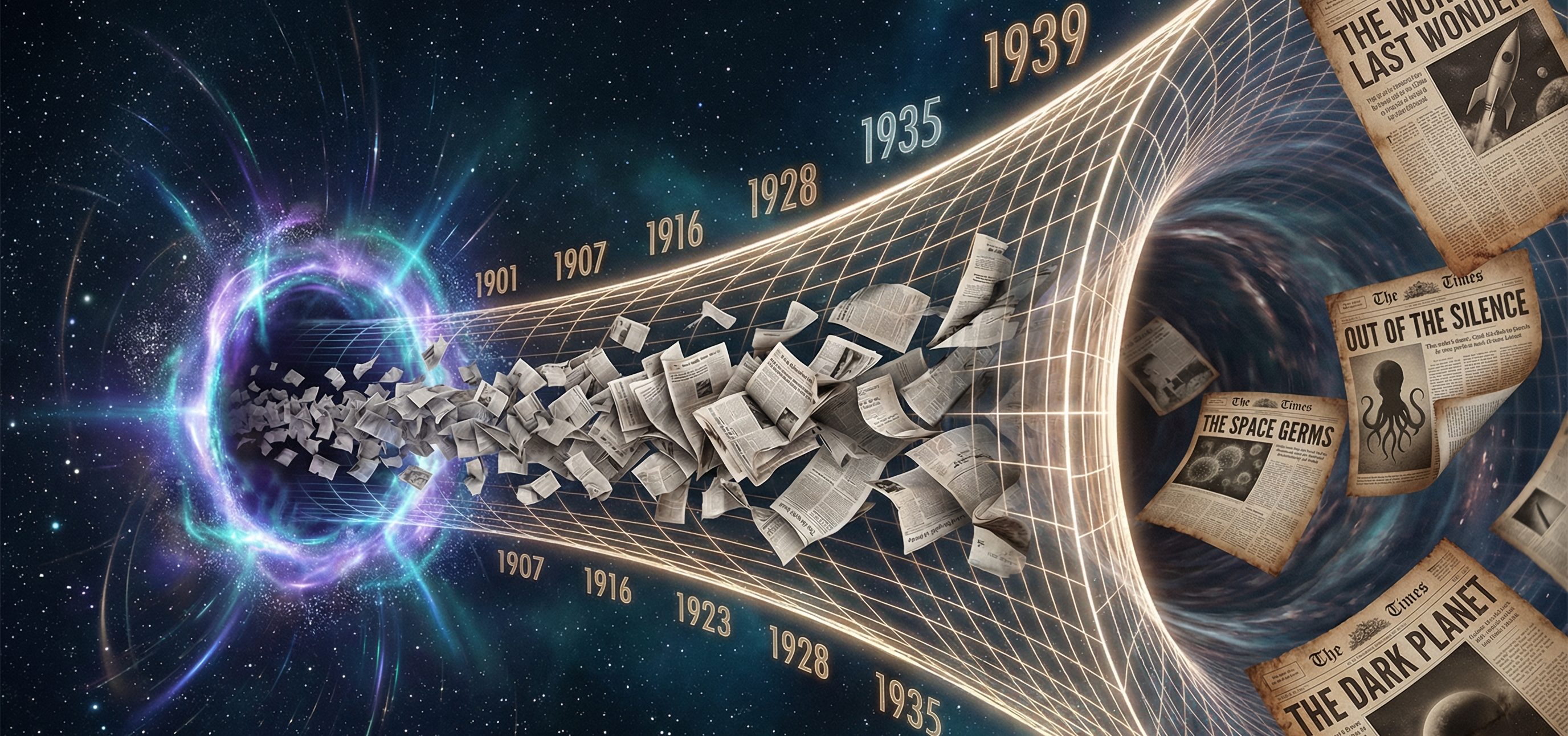
The main focus of IA is on stories that were originally serialised in Australian newspapers between 1901 and 1939. Thanks to the Australian Newspaper Fiction database 'To Be Continued' (TBC) it was possible to locate details of several Vintage Science Fiction Stories. Using various methods and tools used in Digital Humanities, including my own method of keyclouds, as well as creating an Automated Popular English Fiction Genre Classification System (APEFGCS), I was able to find a lot more in the TBC database.
The TBC database extracts OCR'd newspaper fiction sections from the National Library of Australia's archive of newspaper pages in Trove. Once I had found all the vintage science fiction stories I felt I could find with these tools, using my own edited and grouped copy of the TBC sql database, I turned to Trove to locate missing chapters and find more stories. I extended it to finding new vintage science fiction from newspapers from the period 1825 to 1955. This enabled me to locate over 200 serialised and short vintage science fiction stories, many of which haven't been in print since their first publication.
I then chose around 20 stories I could reasonably determine were written in Australia. The stories were not only serialised as separate chapters in multiple newspaper issues, but in some cases, the chapters were also broken into instalments. All these needed to be found, then put into the correct order.
While the main focus of the thesis is 1901-1939, to fill in various gaps in Australian vintage science fiction history, I have added the first (so far determined) Australian science fiction story, along with other stories from the 1800s I've found along the way to this site.
So, with all parts assembled, edited and available in an easy to read, downloadable and printable format, Infinite Anthologies is currently the only place on Earth where you'll find a complete version of several of these vintage science fiction stories from Australian newspapers.
--
The site uses Omeka S, so each story is stored as an item with attached media with over 50 property fields of information for researchers. (Only those fields that contain information are shown.) You are welcome to visit the items and learn about each of the stories, as well as consider the references and arguments Neil has included in the fields.
Content Advisory:
These items are historical texts digitised from their original publication, and reflects the social attitudes, cultural values, and language of the time in which they were created. Some content may include depictions or references that are racist, sexist, ableist, colonialist, or otherwise offensive by contemporary standards. This material is presented uncensored for scholarly, archival, and educational purposes. It serves as a record of past cultural attitudes and is preserved here to support critical engagement, historical reflection, and the advancement of inclusive scholarship. Reader discretion is advised.
On the lower right for a short time is Infinite Anthologies Agent Neil AI which uses a digitised version of Neil's voice. Click to start a voice or text chat with IA's AI! The default of AI agents of recording all chats has been disabled for your privacy. Please consider that this AI agent can make mistakes and currently uses Gemini 2.5 to help answer any questions. In testing Neil noticed that some general questions will generate answers that combine similar vintage science fiction stories (A Trip to the Moon and The Moonman for example.) But, for more specific questions, such as the science behind a specific idea used in a vintage science fiction story, it is a little more accurate.
Legal stuff: The terms and conditions that apply to the site also apply to IA's AI. If you use this site and the AI Agent you are automatically agreeing to the terms and conditions. Thank you.
I acknowledge the traditional custodians of the land on which this collection has been curated, the Wurundjeri Woi-wurrung and Bunurong Boon Wurrung Peoples of the Eastern Kulin Nation, and pay my respects to Elders past, present, and emerging. I recognise the enduring connection of Indigenous peoples to this land and its waters, and I am committed to building a future of respect and reconciliation.