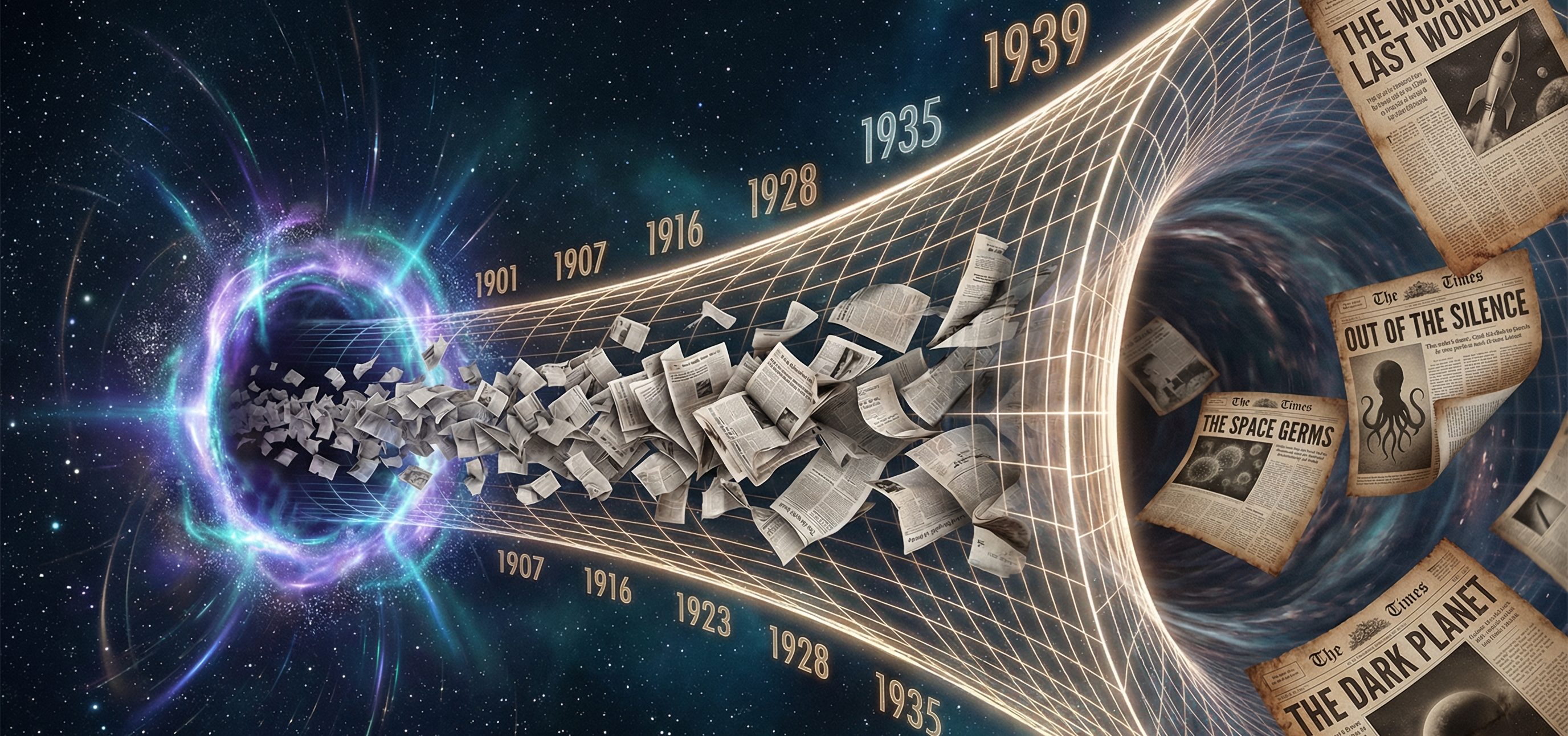
What is Vintage Science Fiction?
My research has led me to consider the following as a usable definition of vintage science fiction (11/10/2025) Note the science-forward nature of the genre.
The genre of Vintage Science Fiction manifests multi-layered science-based meta-realities, rationally prophesizing and extrapolating the developments and effects of contemporary science and technology through educational and purposive narratives which progressively shift readers’ expected ontological paradigms from realism to relativism, reconfiguring, reconstituting and reorienting cognitive habits, perceptions and architecture into expanding the dimensions of self, reality, and possibility.
I arrived at this general definition after reading over 200 stories that I have classifed as vintage science fiction. Breaking some parts of this definition down to more easily understand it -
Multi-layered – stories on the surface may be domestic, romantic, military, satire, or simply describe the everyday world that is taken for granted, yet there is an underlying current that subtly suggests all is not as it seems. There is also the plan by the author to educate a reader in a particular aspect of science and the specific group they wish to teach this time by writing within the initial mode of a romance or detective or adventure. Throughout are behavioural expectations and reactions that the writer expects the reader to be following or the author may wish to change by showing alternative ways to behave. As the late 19th, early 20th centuries still had a focus on class, stories would also be written either focused on a particular class, mix of classes, or feature a world without a class distinction. Some stories through the 1910s and 1920s featured dialogue that represented a more uncouth speaking style by the protagonist, usually a scientist, professor or inventor, as a subtle push against the previous 1890s, and early 1900s featuring highly educated inventors from upper class families, not only indicating that people from every strata of society can be a scientist, professor or inventor, but also subtly telling the reader that, no matter what their social or economic status is, they can be, too.
Science-based – stories feature STEM (science, technology, engineering, mathematics) and explain various principles which can be traced to science articles or science textbooks, before these principles are expanded or extrapolated into evolved versions further into the narrative. This has the element of teaching the reader about a particular science principle that the author may believe the reader should know as well as piquing the curiosity of the reader in the possibilities of what could be the next available concept or invention.
Meta-realities – While it could be argued all fiction texts are meta-realities, by shifting from realism to relativism allows for a specific mode of fiction that is notably beyond any possibilities in day to day life. Meta-realities would apply to horror, fantasy, science fiction, and other genres of fiction that create a world that can be overlaid fictionally on our current world but can’t exist anywhere in our current world.
Rationally – as opposed to empirically. Empirical means that observation, tests, and other concrete evidence is available. Rational means that, based on what is known, assumptions can be made that can be added to what is known, without the need to observe or test or possess evidence. Science fiction is rational in this regard as, if it was empirical, it could just as well be a creative writing journalistic article on science, but the narrative always takes this a step further, beyond empirical.
prophesizing – predicting what will exist next in the world
extrapolating – using what is currently known in science, technology, engineering, mathematics etc to rationally predict what will come next in relation to that science principle or invention
developments and effects of contemporary science and technology – describing, with an understanding of human nature, how the economy, culture, customs and religion, (among other areas), will be changed in society if the science, technology, or invention exists, and how humanity’s future will continue to progressively change as a result.
educational – the style of delivery also targets particular groups of readers to inform them of specific kinds of science
and purposive narratives – there is usually an agenda. It could be as simple as educating readers in an aspect of science the author believes they should know, or it could be to influence a decision such as stories to encourage voting for a particular ideology, or future war stories to encourage conscription, recruitment and higher government spending on weapons.
which progressively shift – stories are written so that the first two to three pages seem perfectly normal until a minor shift happens that suggests not all is what it seems, such as the possible suitor of a girl looking for a husband is announced as an inventor and is suddenly unavailable, or a scientist turns up at a government meeting and informs the ministers of a stolen formula that could cause problems for the country, or if the formula is part of a rapidly escalating narrative, could cause the destruction of Earth.
readers’ expected ontological paradigms – all readers have their own history of fiction knowledge that they bring to interpret new stories. With vintage science fiction being a less encountered fiction, authors slowly introduce the new ontological paradigm (new vocabulary and new ways to interpret current vocabulary) through characters and situations in casual dialogue or explanatory scenarios rather than many modern science fiction works which expect its readers to know the required ontologies before they start reading.
from realism to relativism – realism is the idea that reality exists independently of humanity. Relativism is the idea that we create the reality around us based on our context in relation to it. A science fiction writer consciously or unconsciously shifts the reader’s intention from seeing the world as realistic to seeing the world as relativistic, through the content of the narrative, and the changes in cognition that content is predicted to produce in the reader. In this context, nothing is needed from the reader for a realistic fiction story to be enjoyed as it will reflect their known reality, but a lot is needed for a relativistic fiction story to be enjoyed and for some readers it may even be too much work for them to enjoy it, hence the need to start a reader in familiar territory before reconfiguring and strengthening their cognitive faculties to deal with the learning curve needed to complete the narrative.
reconfiguring, reconstituting and reorienting cognitive habits – it is far easier for a detective mystery fan to become a science fiction fan due to the existing interest in looking for clues in the text and solving puzzles. While a science fiction story doesn’t necessarily have a mystery to solve, the pieces of science, technology, engineering and mathematics discussed can be represented as part of a jigsaw throughout the text, with each additional part of the knowledge of how parts of something work coming together in a stronger understanding of how the whole of it works. Science fiction writers carefully introduce readers into this new style of reading where their usual cognitive habit of looking for the emotion and drama in the text is replaced with looking for the new science.
perceptions – A science fiction writer wishes to convey a particular perspective that is different to the norm, but for new science fiction readers, a writer needs to start with a current perspective then build on that. Many vintage science fiction stories begin with the perspective of human life being unchanging, until it isn’t. This perspective change is usually subtle and built on, such as talking about a new kind of aeroplane so that the reader can adjust their perspective to imagine a sleeker more advanced version, before needing to expand it further when the protagonist describes antigravity plates and oxygen tanks, and the plan to fly into the upper atmosphere. This not only changes the perception of a reader imagining the story, but also changes their perception of what is possible. It’s possible they never considered a balloon could enter the upper atmosphere due to the air being too thin. The narrative showing that science can make something possible, shifts the perceptions of the reader from never considering other possibilities, to being able perceive that future science could solve other problems, too, expanding the horizons of the readers’ conceptual world.
cognitive architecture – the core of a vintage science fiction story is logic, with occasional emotional scenes wrapped around that logic. Some vintage science fiction stories have no biochemical narrative* and are all logic, unlike most other genres of fiction which have a core of emotion with logic on the edges. This means encountering science fiction for the first time may cause some confusion for a reader as the expectations of the reward of neurotransmitters such as oxytocin (emotional connection to characters), norepinephrine (excitement from conflict or tension of a drama), cortisol and adrenaline (stress from suspense) endorphins (from laughing at a character’s behaviour, or just enjoying the pleasure generated by poetic sentences), are not created that often when reading a logical science fiction narrative. There is also the issue of mirror neurons. These are brain cells that activate when we observe (or read) how a character reacts or behaves in a situation that we’re capable of reflecting, for example if a character we have become invested in due to oxytocin gets hurt, we’ll feel their pain. In a science fiction story with situations we’re not familiar with, characters that behave differently to us, and even the addition of ‘the other’ in the form of extraterrestrials that look, move, speak and react differently to how we look, move, speak and react, these mirror neurons are unlikely to fire, again confusing a reader with a story that strangely does not cause much of a reaction in their mind and bodies. So authors lead a new science fiction reader into this mire of logic and emotionless engagement by giving them something else. The kind of emotional reaction that scientists feel when they learn something new or make a new discovery. The story either builds towards this discovery in the form of clues or hints that engage the logical part of the mind that wishes to solve mysteries and puzzles, or the device is their early, yet it has yet to be used, so creates some anticipation and the encouragement to read on. This causes steadily increasing releases of dopamine as the understanding of the science or invention becomes easier. As pieces fit together and more of the technology and its effects are explained and revealed, more dopamine is released, engaging the reader further. As dopamine and acetylcholine ebb and flow in the brain during periods of learning, these are likely to be the dominant chemicals in the brain while reading science fiction, and it is the duty of the science fiction author to rewrite the reader’s brain into being able to engage in that stable learning action, with occasional dopamine spikes. The surprise ending use of the science, technology, concept or invention causes a larger dopamine spike, giving the reader a learning reward rather than the usual mix of chemicals at the end of a romance or tragedy, for example. Darko Suvin describes the invention or concept in a science fiction story as the novum or central idea. It is interesting to note that vintage science fiction usually only has a novum, not nova, and that the meta-realities that the novum manifests do not usually contain more nova, unlike more modern science fiction which contains nova to the extent that someone new to science fiction in the 21st century might be overwhelmed with the amount of learning needed to engage with a particular nova filled fiction text. Vintage science fiction, keeping its focus small, and its story lines more contemporary and suited to reading in a newspaper similar to reading a journalistic article, are much more suited to introducing a new reader to the concept of science fiction, and it is this notable aspect that helps to classify a fiction text as science fiction.
expanding the dimensions of self, reality, and possibility. – Science fiction’s underlying core, whether intentionally or not, is to expand the minds of readers to consider new concepts and see the world through a new lens, ultimately, over successive stories read from a variety of authors, engendering a cosmic awareness in the reader, enabling them to see the bigger picture, the interconnectedness of humanity with the universe. While not all writers focus on doing that specifically, promoters of the benefits to humanity of reading progressive, science-focused science fiction that explores humanity’s positive, technologically enhanced future over the decades have discussed the cosmic awareness that 20th century science fiction readers possessed, before the more introspective, dystopian, techno-fear-based science-less stories of the 21st century removed that sense of awe, wonder, and interest in a reality beyond our own. Vintage science fiction retains that positive future outlook and likely will encourage the same cosmic awareness for new readers of vintage science fiction.
So, this is my definition of vintage science fiction. Perhaps it can be extended to the early 1890s. Before then I would define science fiction between 1832 and 1889, in Australia at least, as invention opera, with a much greater focus on a romance surrounding a single invention than the invention being the fulcrum or catalyst of a vintage science fiction story.
To see how modern and inventive Vintage Science Fiction from Australian Newspapers is, I thoroughly recommend you begin with The World's Last Wonder (1901) our first space opera.